

About twenty years ago, TAUS founder Jaap van der Meer predicted that translation would become a utility: something you could tap into as easily as electricity from a wall socket. That prediction has largely come true. But the version of it we’re living in now is bigger than anyone expected.
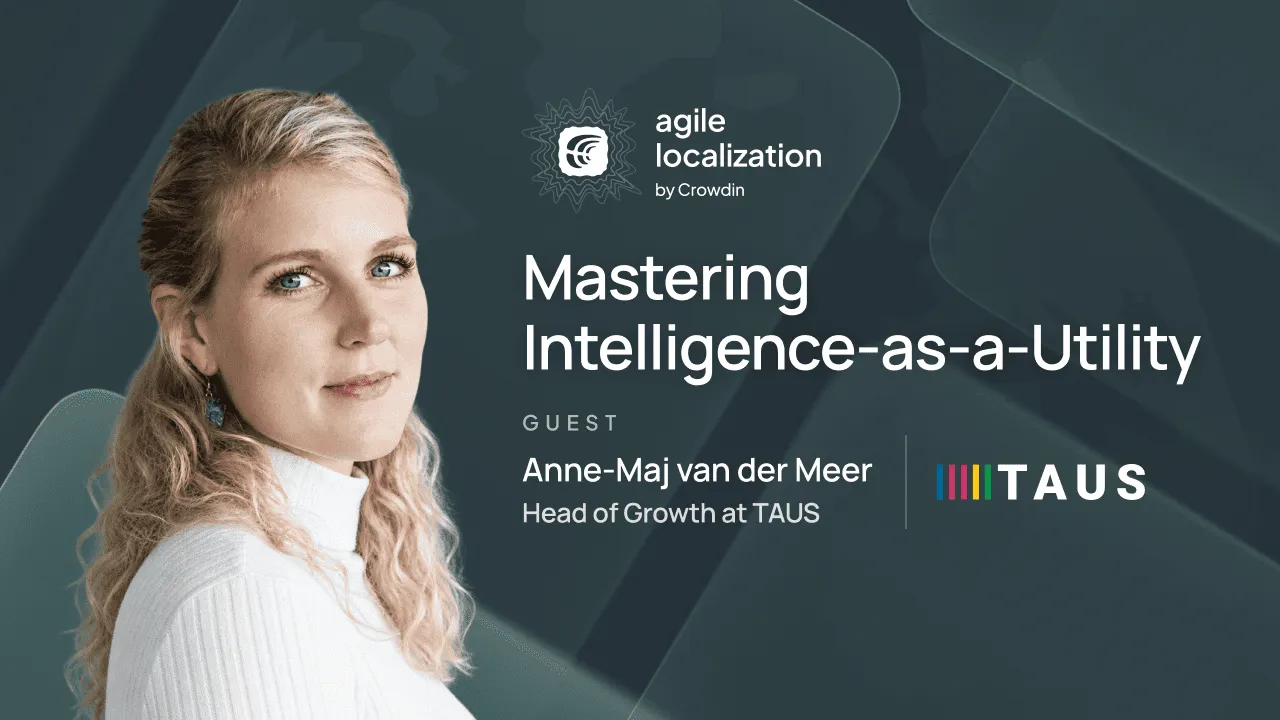
On a recent episode of The Agile Localization Podcast, host Stefan Huyghe spoke with Anne-Maj van der Meer, Head of Growth at TAUS, ahead of the TAUS conference in Vancouver: The Art of Mastering Intelligence-as-a-Utility. This year, the event runs alongside LocWorld as part of the first Vancouver Localization Week. Their conversation shows how the challenges facing the localization industry have changed.
Listen to the new episode on:


From accuracy to differentiation
Twenty years ago, the “translation as a utility” idea was about basic access: making raw statistical machine translation available to everyone. The main obstacle was quality. Could the output be trusted?
Today, large language models have turned intelligence itself into a utility. Every enterprise has equal, inexpensive access to the same models, so the problem has changed.
"The challenge then was more about accuracy, and I think today it’s more about control and differentiation.
When your competitors use the same tools you do, the output stops being an advantage. Language moves from operational cost to a core driver of brand identity, user experience, and sovereignty.
The risk of defaulting to the average
The TAUS program puts a concern at its center that might seem unusual for a technology conference: cultural loss.
The reasoning is simple. If every brand relies on the same generic LLMs trained on the same internet datasets, languages start to flatten. Regional idioms disappear. Cultural nuance fades.
"We know that technology without cultural nuance is really failing in the real world.
In Anne-Maj’s view, the value of human expertise has moved:
"It’s not really any more about fixing the typos, but it’s preserving the cultural identity and exercising critical judgment where algorithms default to the average.
Why the money is still flowing
If translation is cheap and instant, why are private equity firms still investing in the language space? The conference opens with this question because it sets the economic reality for everything that follows.
The industry is seeing real growth stories alongside mergers and bankruptcies. Investors aren’t betting on word output. They’re looking at what sits around it: data infrastructure, orchestration pipelines, and specialized domain intelligence.
Enterprises, shadow localization, and the future LSP
Enterprise leaders are under growing pressure to build multilingual capability in-house. Translation work is happening across organizations outside of official localization programs. With more AI in the mix and more teams working independently, how do companies keep their brand reputation safe?
For language service providers, the questions are even more fundamental. If LLMs can handle translation, will an LSP still be an LSP? Some may evolve into software platforms that bundle access to specialized providers’ APIs. Others may position themselves as the human data layer. Anne-Maj expects a lively disagreement on the LSP transformation panel, which she co-hosts with Renato Beninatto.
There is no best LLM
"Any provider can claim that they’re the best, but what does it mean? And indeed also the best at what and at what cost?
Leaderboards don’t answer the questions procurement teams actually face. How does a model handle domain-specific content? Can it meet real-time latency demands at high volumes? Does it support low-resource regional dialects? What will it cost in tokens?
The answer is never a single winner. It’s the right model, fine-tuned for the right context. The session aims to define what a trustworthy, independent benchmarking framework should look like.
TAUS builds its own quality estimation technology, but Anne-Maj doesn’t see a conflict. TAUS has always been a facilitator first, she says, and on stage its role is education.
Bringing raw ideas back to the stage
The conference also introduces the Sandbox. Traditional innovation contests had drifted toward polished marketing showcases, while early editions had featured now-established localization companies back when they were just scrappy ideas pitched from the floor.
The Sandbox brings that raw energy back. Participants get three-minute pitches with no slides. In the afternoon Polish session, each table takes one idea and helps refine it into a workable solution, and live voting picks the winner.
"As long as you have a real workflow headache, you can jump on the stage and share it.
One week, one complete picture
TAUS and LocWorld have often co-located their events. So when both were heading to Vancouver a weekend apart, Vancouver Localization Week made sense. LocWorld focuses on global business growth and client-vendor ecosystems, while TAUS goes deeper into AI, language data, and orchestration. Together they give attendees a complete view of an industry in transition.
"The most important measure of success is knowing attendees are going home with fresh inspiration and excitement about their work and the localization industry – but also concrete solutions to their questions and challenges, and stronger, broader connections.
Anne-Maj’s background
Anne-Maj van der Meer is Head of Growth at TAUS, where she shapes the conference agenda alongside TAUS founder Jaap van der Meer. She has worked in localization events since 2005, starting with logistics support at LocWorld Bonn and later hosting and managing LocWorld’s translation automation track. At TAUS, Anne-Maj turns big-picture visions of industry disruption into practical, tangible programs, and she champions formats that put open, unscripted conversation and audience participation at the center.
The views, thoughts, and opinions expressed in this podcast are the speaker’s own and may not necessarily align with those of Crowdin.
Listen to the new episode on:
Localize your product with Crowdin

Yuliia Makarenko
Yuliia Makarenko is a marketing specialist with over a decade of experience, and she’s all about creating content that readers will love. She’s a pro at using her skills in SEO, research, and data analysis to write useful content. When she’s not diving into content creation, you can find her reading a good thriller, practicing some yoga, or simply enjoying playtime with her little one.