

When your product is used by a seven-year-old learning multiplication, a university professor running a pop quiz, and an HR manager onboarding new hires, all in the same afternoon, across 22 languages, localization stops being a translation exercise and starts being something closer to cultural choreography.
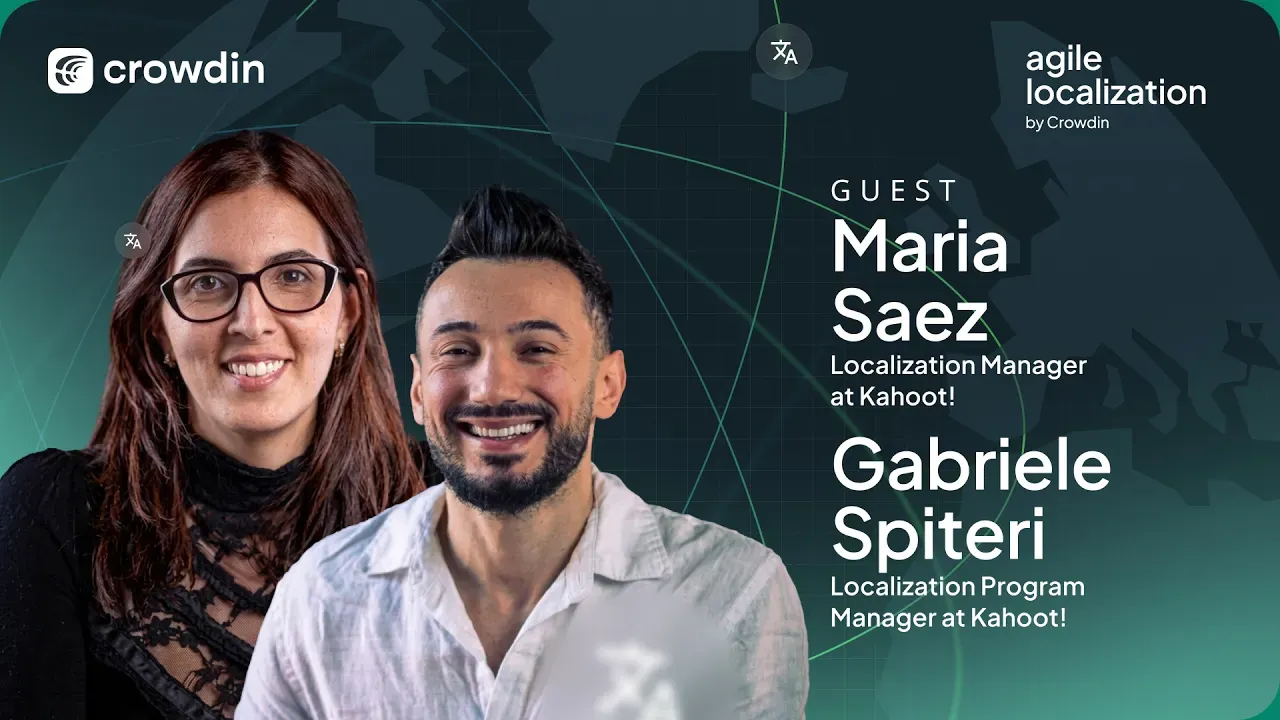
That’s the world Maria Saez and Gabriele Spiteri live in every day. On a recent episode of The Agile Localization Podcast, host Stefan Huyghe sat down with Kahoot!‘s Localization Manager and Localization Program Manager to unpack how they keep a platform that’s simultaneously an e-learning tool and a live game experience feeling native everywhere it lands.
Listen to the new episode on:


Centralize the decisions, decentralize the experience
Gabriele uses a simple test to decide what belongs in a shared localization system and what needs its own operating model.
"You need to think about the risk, cost, or friction you’d face if something weren’t shared — that’s what you centralize. Then ask the same question the other way: what risk, cost, or friction would you face if it were shared? That’s what you decentralize.
At Kahoot!, the decision framework, the TMS, the automation, and the content repositories sit in the middle. Workflows fan out from there. His favorite example: take a tooltip that’s seasonal and will disappear tomorrow, or a button sitting right next to Pay Now on the payment page. “They’re both UI strings, but they serve completely different purposes — you wouldn’t translate them the same way or give them the same importance.”
The “False Sufficiency” Trap
Gabriele has a warning for anyone building a localization program:
"The goal of standardization and automation should be to reduce unnecessary labor-intensive work, not to eliminate it.
When two content types look similar on paper, it’s tempting to funnel them into the same workflow. But that’s how you end up with millions of pre-translated words that all technically work, and none of which actually fit. The fix is better localization metadata and variation that’s controlled and intentional.
Human, AI-assisted, or fully automated?
At Kahoot!, the decision starts with one question: “What’s the cost of getting a piece of copy wrong?” Gabriele says. That cost is more than just financial. There’s opportunity cost: could AI free up capacity to enter new markets? And, crucially for a game platform, there’s behavioral cost. A mistranslation might not just confuse a user; it might change how they behave in the game, or erode their trust entirely.
“We could also lose trust of the user, or create a disruptive experience for them,” Maria adds.
These decisions happen upstream, “in the same room as engineers, designers, and copywriters,” Gabriele says. Localization as an afterthought is exactly what Kahoot! is trying to move away from.
One product, wildly different audiences
"Just when we felt we had our style guides nailed, our glossaries nailed — we’re flying, we have great collaboration with our linguists, we’re creating great quality copy — you realize you have to dive deeper.
Her team ended up creating additional documentation and even language-specific guidance on top of the master guides. Kids’ content, for instance, leans on emojis, imagery over text, and deliberately dials down the competitive edge. Corporate training copy is more formal and sustained. Teacher-facing material highlights the formative aspect. Teenager content leans into fun.
The user-generated puzzle
With 60 million public user-generated Kahoots on the platform, Kahoot! doesn’t try to compete with its community — it builds for it.
"We don’t try to compete with that. We try to make our own content. The input from people all over the world, making Kahoot their own — that’s what makes Kahoot great.
Kahoot! doesn’t localize user-generated content, but it builds the platform so creators can make Kahoots in as many languages as possible, whether or not the company officially supports those languages in the UI.
Software or game?
Localizing Kahoot! means treating it as both — and that duality shapes every decision.
"Kahoot! is both a software and a game. On one hand you need linguistic equivalence, functional equivalence, the behavioral response from the user. On the other, you have the mechanics of the game — and competition isn’t the same across markets. It may be something to look forward to in the Western world, but in other areas it may be frowned upon.
A single Kahoot can be played 35 different ways — competitive or not, in teams, individually, in a classroom, or at home for self-review — and localization has to hold up across all of them.
What actually counts as success?
Maria ranks linguistic equivalence last among her success metrics.
"I would say linguistic equivalence would be the least important one of our parameters.
What she actually watches: are people playing the games? Are they visiting the sites? Do they drop off after hitting a localized experience? Do sign-ups convert to subscriptions in a given country? What are support tickets telling the team? “We work very closely with our community — we have more than 10 million global educators who participate, give feedback, and come back to use the tool,” Maria says. Localization can’t be pinned directly to revenue. But the trend line tells you everything you need to know.
Maria and Gabriele’s background
Maria Saez is a Localization Manager at Kahoot!, the global learning and engagement platform, where she oversees multilingual experiences across the company’s product UI, marketing, websites, partner content, and learning applications. Maria leads the work of aligning glossaries, style guides, and creative content with the wide range of audiences Kahoot! serves and champions bringing localization into the earliest stages of content and product creation.
Gabriele Spiteri is a Localization Program Manager at Kahoot!, where he designs the frameworks that decide what gets centralized, what gets decentralized, and where AI belongs in the localization workflow. His work spans language launches, market entry strategy, and the behavioral and cultural mechanics that shape how Kahoot!‘s games and learning experiences land across different regions. Gabriele is a strong advocate for moving localization upstream so that language, functionality, and user experience are shaped together rather than translated after the fact.
The views, thoughts, and opinions expressed in this podcast are the speaker’s own and may not necessarily align with those of Crowdin.
Listen to the new episode on:
Localize your product with Crowdin

Yuliia Makarenko
Yuliia Makarenko is a marketing specialist with over a decade of experience, and she’s all about creating content that readers will love. She’s a pro at using her skills in SEO, research, and data analysis to write useful content. When she’s not diving into content creation, you can find her reading a good thriller, practicing some yoga, or simply enjoying playtime with her little one.