

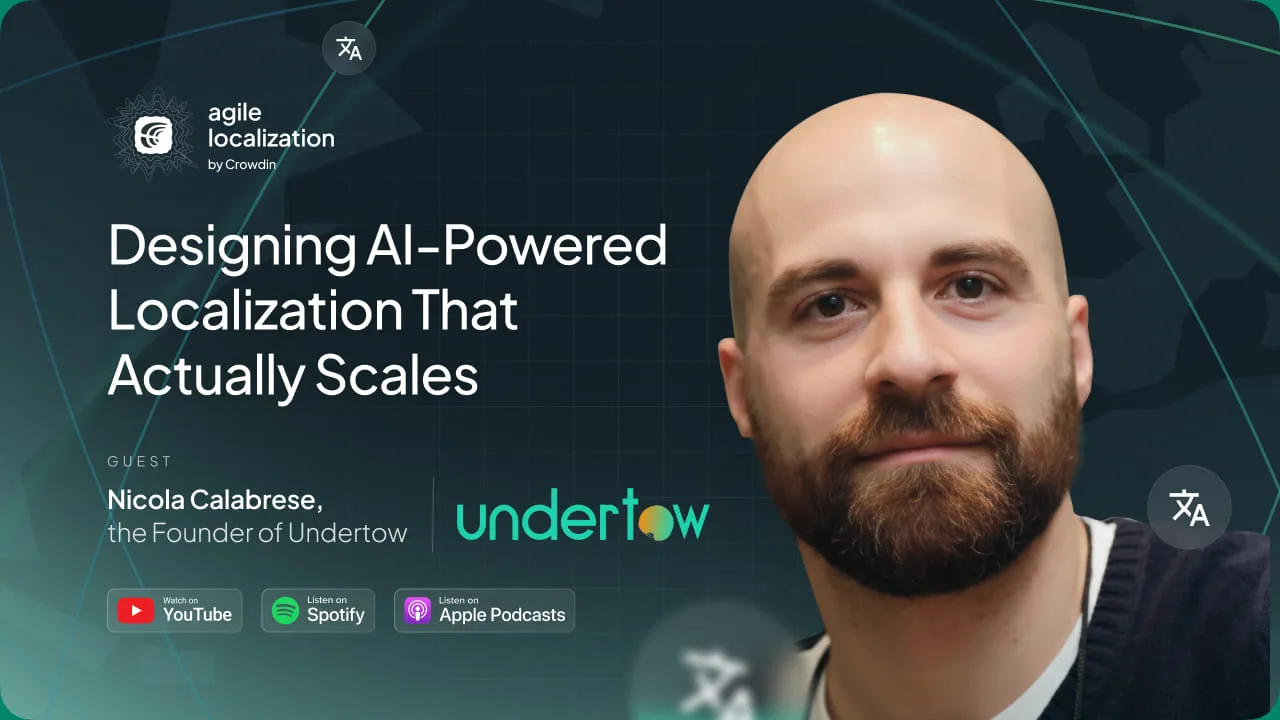
When B2B SaaS companies talk about going global, what they often mean is: send content in, get translations out, and hope for the best. In reality, that approach breaks the moment you try to scale.
In this episode of The Agile Localization Podcast, host Stefan Huyghe is joined by Nicola Calabrese, the Founder of Undertow, to dive into how B2B SaaS companies can build structured, scalable localization programs powered by AI. With more than a decade in software localization, SEO, and process design, Nicola makes one thing clear: AI doesn’t fix chaos. It amplifies it.
Here’s how to avoid that trap.
Listen to the new episode on:


4 Pillars of a Modern Localization Program
According to Nicola, every scalable localization setup rests on four essential pillars:
1. Strategy
Localization cannot exist in a vacuum. It has to align with business goals. If leadership cares about revenue, expansion velocity, or customer retention, your localization strategy must directly support those outcomes. Saying “we improved translation quality” won’t move the needle in the boardroom. Showing that better localization unlocked three additional campaigns per quarter or accelerated market entry by two months.
2. People
AI is powerful, but as tech stacks grow more complex, skilled people become even more critical. Someone still needs to design workflows, maintain glossaries, interpret context, and make strategic decisions. Localization managers shouldn’t be isolated operators buried under operational chaos. They need structured support.
3. Tech
Modern infrastructure matters. A centralized translation management system (TMS), connectors to CMS platforms, integrations with GitHub and email providers, and customizable AI workflows are foundational.
4. Processes
The “boring” pillar, and arguably the most important. Clear, documented processes eliminate bottlenecks. Without them, teams rely on copy-paste workflows, scattered Excel glossaries, and internal reviewers juggling translation on top of their actual jobs.
Red Flags That Your Localization Won’t Scale
Nicola sees the same warning signs repeatedly.
- If a company treats localization as “just translation”, that’s a problem.
- If sales reps or marketing managers are reviewing translations manually, that’s a problem.
- If there’s no centralized glossary, no ownership, and no defined workflows, that’s a problem.
These setups might survive in one or two markets. Add a third language, or expand campaign volume, and everything collapses. Often, there’s a single internal person who speaks the language. If they go on vacation, the entire process stalls.
AI doesn’t solve this – it accelerates the breakdown.
The Minimum Viable Experience Framework
When entering a new market, Nicola doesn’t recommend translating everything. Instead, Nicola applies what he calls a Minimum Viable Experience (MVE) analysis. This means mapping the entire customer journey:
- Ad campaign
- Landing page
- Product signup
- Onboarding emails
- Activation flows
- Help center content
- Renewal touchpoints
- Then prioritizing only what’s essential.
If you have 100 help center articles, you don’t localize all 100. You localize the onboarding emails and the most visited support pages linked within them. If entering Germany and France, messaging may differ. German customers may prioritize data security and GDPR compliance. French customers may value native-language support and human connection.
Same product, different emphasis. By launching with a focused, connected experience, companies gather real traction data. That data becomes leverage internally to double down or reallocate resources intelligently. Localization becomes a growth experiment, not a cost center.
Why Translation Management Systems Still Matter
There’s a popular narrative that AI will replace TMS platforms. Nicola disagrees. Without a TMS, teams end up rebuilding what TMS platforms already solve: version control, terminology management, automated workflows, connectors, and QA layers.
Localization today operates on three levels:
- Direct translation
- Adaptation
- Market-specific creation
A TMS handles the first layer efficiently. That frees teams to invest time in the final 20 percent. AI inside modern TMS environments accelerates micro-tasks that used to take hours:
- Converting US English to Australian spelling
- Adjusting gender agreements in languages like Italian
- Switching between formal and informal tone
- Fixing syntax errors in WordPress files
- Updating numbering conventions across content
"Another thing that I like about Crowdin is that it allows me to set up visual workflows without having to write code. It’s literally a drag and drop and setting up, AI steps that can be customized for the different workflows and even the different content types and different languages, taking into account style guides, glossaries, previously done content.
90-Day Blueprint to Get Started
For companies ready to build an AI-driven localization program, Nicola suggests a practical three-month roadmap:
Month 1: Assess Reality
Audit your current setup. Identify manual bottlenecks, unclear ownership, outdated glossaries, and disconnected AI localization experiments.
Month 2: Align Strategy and Resources
Define target markets. Quantify internal time spent on localization. Connect improvements to measurable business outcomes.
Month 3: Upgrade Tech and Processes
Implement or optimize a TMS. Centralize terminology. Trim unnecessary workflow steps. Introduce AI where it meaningfully reduces friction.
Localization maturity doesn’t happen overnight. But within 90 days, companies can shift from reactive translation to structured global enablement.
Final Thoughts From Nicola
AI is changing localization. But technology alone doesn’t create scale. Strategy, people, infrastructure, and disciplined processes do. And when those foundations are in place, AI becomes what it should be: a multiplier.
Nicola’s Background
Nicola Calabrese is the Founder of Undertow, a specialist firm helping tech companies build and manage AI-powered localization programs. With over a decade of experience in software localization, SEO localization engineering, and process design, Calabrese brings a strategic perspective grounded in operational excellence. He also hosts The Multilingual Content Podcast, teaches at the Localization Management Academy TranslaStars, and develops educational content on workflow automation and AI agents for the localization industry.
The views, thoughts, and opinions expressed in this podcast are the speaker’s own and may not necessarily align with those of Crowdin.
Listen to the new episode on:

Yuliia Makarenko
Yuliia Makarenko is a marketing specialist with over a decade of experience, and she’s all about creating content that readers will love. She’s a pro at using her skills in SEO, research, and data analysis to write useful content. When she’s not diving into content creation, you can find her reading a good thriller, practicing some yoga, or simply enjoying playtime with her little one.