

Ask a technical writer what defines their craft, and for the last two decades the answer has been simple: the how-to. Step-by-step instructions, error-free configurations, the manual that tells you exactly which button to click. That era is quietly ending.
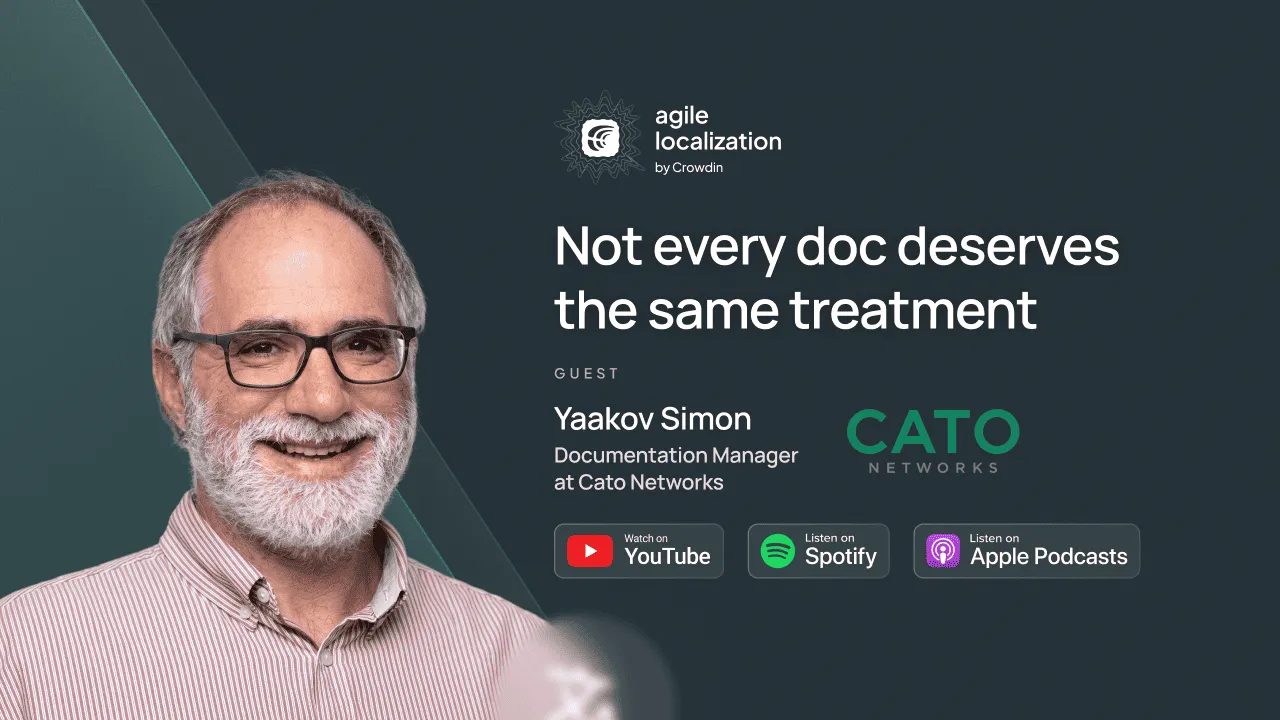
In a recent episode of The Agile Localization Podcast, host Stefan Huyghe sat down with Yaakov Simon, Documentation Manager at Cato Networks to discuss what happens to documentation when AI can already answer most “how do I…” questions on its own.
Listen to the new episode on:


The how-to is no longer king
"I’ve been doing technical writing for eighteen years, and when I started, the how-to was it. That was what defined a technical writer.
Today AI is the new king of the how-to.
That’s a bold acknowledgment from someone who has spent nearly two decades writing how-tos. But his point is that the value has moved. Instead of documenting how to configure a feature, tech writers now need to explain why it matters by answering, “How does it help customers extract real value from the product?”
Documentation as customer advocate
One of the most striking moments came when Stefan asked whether customers ever understood the documentation better than the engineers who built the product. Yaakov didn’t hesitate.
"The engineers really struggle to understand how the customers are using our feature. Often the customers do kind of understand the documentation better than our engineers.
That’s the tech writer’s leverage. Sitting between engineering and end users, they become the customer’s voice inside the organization, pushing back when a specification sheet isn’t enough, insisting that the full value of a feature gets communicated.
Reactive and proactive partnership
At Cato, documentation and support form what Yaakov calls a reactive-proactive partnership. Technical writers produce proactive content. Support handles the reactive side, writing troubleshooting articles for edge cases customers hit in the wild. Take support out of the picture, and he’d have to redesign the whole practice from scratch: more FAQs, more troubleshooting, a completely different focus.
The Model T versus Ferrari approach
Not every article deserves the same treatment. Yaakov borrowed a framing from a conference talk he loved:
- Some documentation is a Model T: standardized, functional, interchangeable how-tos that just need to exist.
- Other pieces are Ferraris: deeply crafted, high-effort content for a specific audience that may never rack up big page views but delivers outsized value to the readers who need it.
Page views alone will never show the value of a Ferrari. A better frame is enablement versus visibility: are customers actually clicking through the UI after reading a release note? Tools like Fullstory can answer that in ways a raw view count never will.
Documentation that influences the CTO
A newer strand of Yaakov’s work targets not IT admins but C-level buyers. He’s producing pieces pitched at CTOs and CISOs: fluent in terms like ZTNA and data sovereignty, and framing product value in ways that feed into purchasing decisions. It’s a category his team wasn’t producing a year ago, and AI is what made it practical.
The AI-era translation memory
Yaakov’s previous life as a localization manager at Check Point still shapes how he thinks. His most valuable asset back then was the translation memory, the authoritative bank of approved translations he treated “like gold bars.”
His new idea: build a knowledge bank of authoritative technical content that AI can reuse across the documentation set. Update it once, and the AI propagates the change everywhere. It’s TM logic reborn for the age of LLMs.
For the localization side of the house, tools like Crowdin remain critical. The ability for local subject matter experts to jump in and correct localized content directly is going to stay indispensable no matter how good AI translation gets.
Staying sticky
The tech writers who thrive in the AI era won’t be the ones who write the cleanest how-to. They’ll be the ones who become indispensable product experts (or sticky, in Yaakov’s SaaS-flavored language) and who use AI to move up the value chain toward the executives, buyers, and strategy.
Yaakov’s background
Yaakov Simon is the Documentation Manager at Cato Networks, a leader in the SASE (Secure Access Service Edge) space, where he leads the team responsible for product documentation and localization. With 18 years of experience in technical writing, Yaakov previously spent time at Check Point, where he documented security appliances and served as Localization Manager for the product organization. His career spans the full breadth of technical content, from API documentation and multilingual printed guides to AI-driven technical marketing content aimed at C-level decision-makers. A vocal advocate for evolving the role of the technical writer in the age of AI, Yaakov focuses on deep product expertise, cross-functional collaboration, and building documentation practices that create measurable value for both customers and the business.
The views, thoughts, and opinions expressed in this podcast are the speaker’s own and may not necessarily align with those of Crowdin.
Listen to the new episode on:

Yuliia Makarenko
Yuliia Makarenko is a marketing specialist with over a decade of experience, and she’s all about creating content that readers will love. She’s a pro at using her skills in SEO, research, and data analysis to write useful content. When she’s not diving into content creation, you can find her reading a good thriller, practicing some yoga, or simply enjoying playtime with her little one.