

When most of us think about localization, we picture someone quietly working through spreadsheets, swapping words from one language to another.
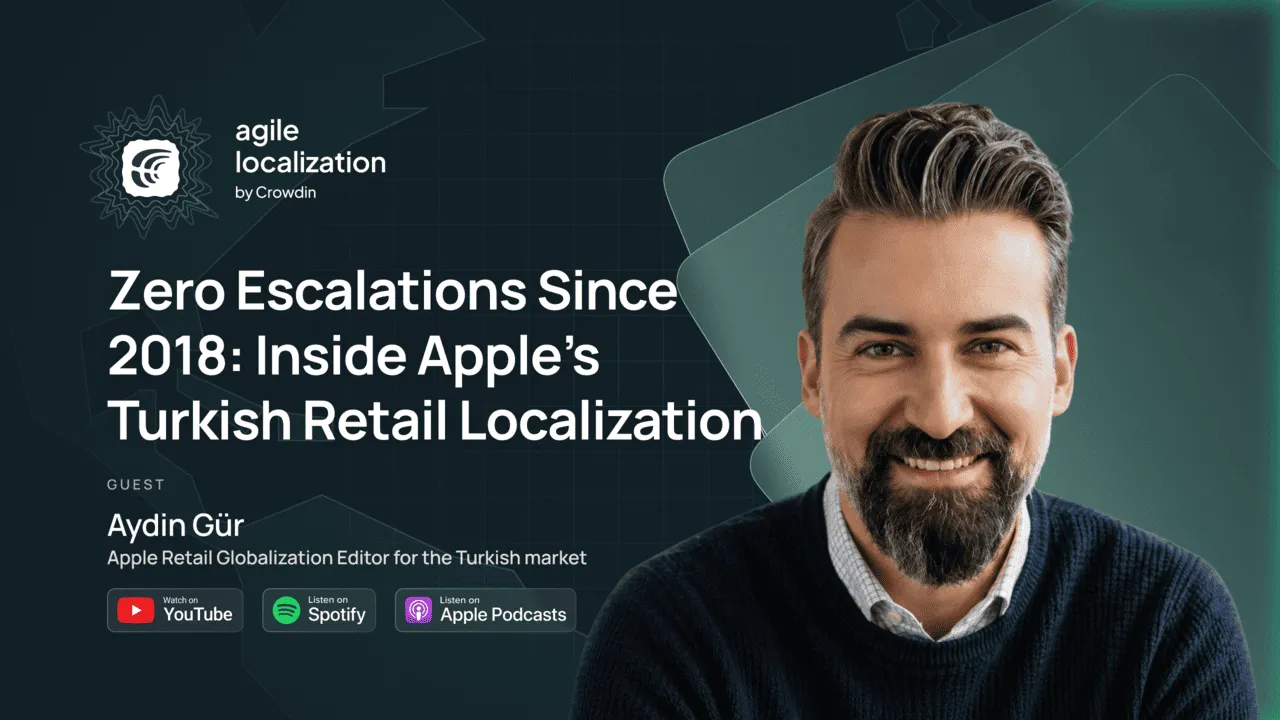
Aydin Gür’s reality couldn’t be further from that image. As an Apple Retail Globalization Editor for the Turkish market, he’s reviewed and signed off on over 10 million words of customer-facing content, and his team hasn’t had a single escalation since 2018.
In this episode of the Agile Localization Podcast, host Stefan Huyghe sat down with Aydin to unpack how he pulls that off, and the stories he shared were equal parts illuminating and entertaining.
Listen to the new episode on:


When a ‘perfect’ translation blows up on social media
One of the most memorable moments in the conversation was Aydin’s cautionary tale about a Genius Bar customer survey. The translation was technically flawless. Every term was correct. Every string was reviewed. And then a Turkish parody account on Twitter got hold of it.
The survey asked customers about the performance of the Genius who helped them. In Turkish, the word carried an unfortunate double meaning, one that the parody account was more than happy to exploit in the most obscene way possible.
The post went viral. Apple headquarters started sending panicked messages. Aydin’s team had to scramble to convince leadership that, no, the translation wasn’t wrong. Someone was just weaponizing ambiguity for laughs.
They changed the wording anyway. The lesson is that a translation can be linguistically perfect and still fail spectacularly in the real world.
The feedback loop that dashboards can’t replicate
Aydin made a compelling case that the most valuable quality signals in retail localization don’t come from dashboards or QA metrics. They come from people on the store floor. Aydin described localization as an often isolated profession where freelancers deliver work and rarely see its impact. But in retail, the feedback is immediate and direct.
Store employees see details that editors don’t. They know how customers actually talk, which technical terms people use in English versus Turkish, and where official translations feel stiff or unnatural.
"People in retail, when you communicate with them, they really show you they value your work, and this is important for them. They really think about the quality, about what you deliver to them, and they are very, very eager to share their opinions about your work.
His team regularly reaches out to store staff before deliveries to gather context: How is this term used in your local circle? Do customers say the Turkish word, or do they just use the English one?
A perfect example: the word ‘email’. Turkish has a perfectly good formal translation for it. But store employees told Aydin’s team that customers just say ‘mail’ in English. So they switched.
The same thing happened with the pronunciation of ‘iOS’. In English, it’s ‘eye-oh-ess’. But Turkish users say ‘ee-oh-ess’, which changes how suffixes attach to the word. In an agglutinative language like Turkish, where meaning is built by stacking suffixes onto root words, pronunciation reshapes grammar.
What zero escalations actually looks like
When Aydin says “zero escalations”, he means something specific: no one outside his immediate team has had to intervene to fix a problem since 2018. If small errors happen, they get caught and resolved before anyone in leadership ever sees them. The mechanisms are already in place.
Getting there required breaking down the walls that typically separate localization teams from the rest of the business. Aydin’s team knows every translator working on their account by name. They vetted each one individually, reviewed their test translations, and chose who to work with. They hold regular feedback sessions twice a month, face-to-face, with translators and vendor project managers alike.
Aydin acknowledged that large language service providers offer tremendous scale and fast turnarounds, but noted the trade-off: “Your team can become a black box”. In his view, solving that opacity problem was the single biggest factor in achieving consistently high output.
Enterprise rigor vs. indie passion
Some of the most interesting contrasts came when Aydin discussed his work on Fortnite alongside his Apple retail responsibilities. The workflows are worlds apart, especially when you compare enterprise clients to smaller indie game studios.
Enterprise clients care about processes. They send offline files, enforce strict character limits, and run rigorous QA checks. The people you deal with are professional and measured.
Indie studios, on the other hand, treat their game like a life’s work. They will give you access to a dedicated game localization branch on GitHub, integrate you directly into their development pipeline, and pour visible emotion into every detail.
From Dungeons & Dragons to Apple Retail
Aydin learned English thirty years ago through tabletop RPGs and classic LucasArts adventure games.
With essentially zero Turkish content available, he bought Dungeons & Dragons books and worked through them with a dictionary. Story-rich point-and-click adventures like Indiana Jones and the Fate of Atlantis and Full Throttle pushed him further.
It’s a fitting origin story for someone who now sits at the intersection of language, culture, and technology, and a reminder that the best localizers aren’t just linguists. They’re people who fell in love with the power of words in context, long before it became their job.
Aydin’s background
Aydin Gür is an Apple Retail Globalization Editor for the Turkish market, bringing over a decade of expertise in managing localization at the intersection of global brand standards and local market realities. With a unique background spanning film translation, game localization, and enterprise retail content, Aydin has reviewed and approved over 10 million words across in-store, digital, and print channels for the Turkish market. His experience directly engaging with store employees and end users has shaped a pragmatic approach to localization that prioritizes consumer language over formal convention, making him an invaluable resource for professionals navigating the complexities of rapid, high-stakes localization workflows.
The views, thoughts, and opinions expressed in this podcast are the speaker’s own and may not necessarily align with those of Crowdin.
Listen to the new episode on:

Yuliia Makarenko
Yuliia Makarenko is a marketing specialist with over a decade of experience, and she’s all about creating content that readers will love. She’s a pro at using her skills in SEO, research, and data analysis to write useful content. When she’s not diving into content creation, you can find her reading a good thriller, practicing some yoga, or simply enjoying playtime with her little one.