

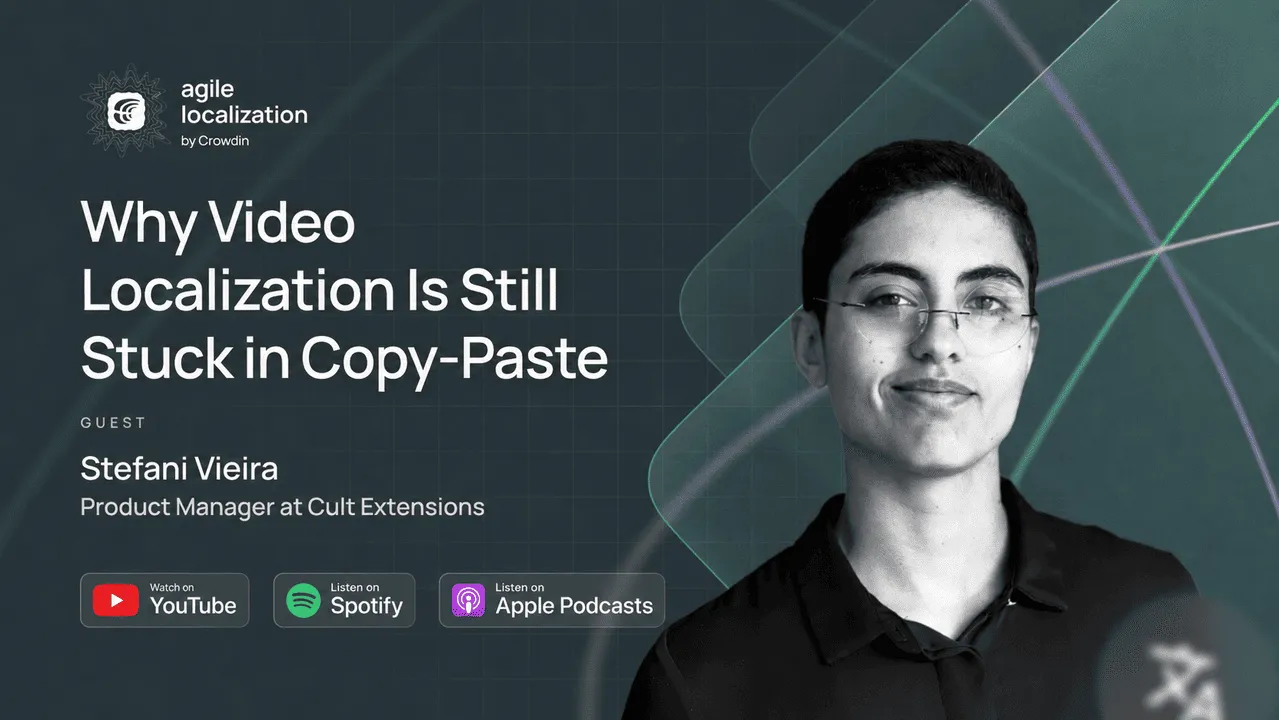
Video makes up roughly 80% of all internet traffic. And yet, when it comes to localization, video production has been operating in a world of copy-paste chaos, disconnected from the very workflows that have modernized everything else.
In this episode of The Agile Localization Podcast, host Stefan Huyghe sits down with Stefani Vieira, a Product Manager at Cult Extensions, to explore how modern video localization can escape fragile manual processes and integrate into the broader localization ecosystem.
Listen to the new episode on:


Video is everywhere, except in the localization pipeline
The internet runs on video, but video production hasn’t been integrated into localization workflows the way text and static assets have. Why? Because video typically lives under marketing. And product development is where companies tend to focus their automation energy.
The result is that video producers have been stuck manually extracting text from After Effects compositions, handing it off for translation, and then pasting translated strings back in. For anyone localizing into 18 languages, the math gets ugly fast.
That’s the problem Stefani and her team at Cult Extensions set out to solve. Their connector plugs Adobe After Effects directly into Crowdin, letting teams tag strings inside their compositions, push them out for translation using existing glossaries and translation memory, and pull the localized versions back in with a couple of clicks. According to Stefani, this approach cuts localization time for motion assets by roughly 80%.
When translators can see what they’re translating
What happens when translators can actually see the animation they are translating for?
Unlike static content, video communicates through multiple channels simultaneously: text, motion, pacing, emphasis, color, and sound. When a translator only gets a stripped-out string with no visual reference, they are working blind. Is it a headline that flies across the screen in two seconds? A subtitle that has to sync with a dramatic pause?
Giving translators the visual sequence eliminates a whole category of errors. They can judge whether a phrase fits the timing of the animation, whether the tone matches the mood of the scene, and whether a longer translation in, say, German, will break the layout.
It’s faster, it scales better, and it produces fewer rounds of costly adjustments. And in video, every adjustment means re-rendering, which can take anywhere from 30 minutes to several hours per piece, multiplied by every language.
"When translators work on static content, seeing the layout helps them understand where text will be placed, giving them context on whether a longer phrase will fit.
In video, seeing the frame sequence helps you understand the pace and other information. When translating text for motion and video, translators must work with these additional communication channels.
It’s a more complex system. Providing this sequence and image context helps avoid translations that don’t fit the motion of the piece, as well as layout mistakes.
Start measuring feelings
Stefani argues that the localization industry is measuring incomplete metrics. Conversion rates, click-throughs, and watch counts are easy to pull from any analytics dashboard, and they’re useful, but they don’t tell you whether your localized content actually resonated with the audience. Did the message land emotionally? Did it feel native, or did it feel like a translation?
The good news is that sentiment analysis has gotten easier thanks to AI. A few years ago, pulling YouTube comments, cleaning the data, and running a proper sentiment analysis required a dedicated technical team. Now it’s accessible enough that localization teams should be incorporating it. When you combine quantitative throughput metrics with qualitative sentiment data, you start to see the full picture.
"I wouldn’t say the metrics we measure [in localization] are wrong, but they are incomplete for understanding the overall picture of how a piece resonates with the audience.
Metrics like conversions are easy to access in performance software and easy to understand. You have clicks or views over global totals, which are useful to an extent.
However, when trying to measure sentiment and audience understanding, you need to dive deeper into their actual responses.
She also flags an underappreciated trap: confirmation bias in content creation. Teams might research a market and design content based on assumptions that feel validated by their research. But the research itself was shaped by those assumptions. A/B testing localized versions against real audience behavior is one of the best ways to catch this, and the tools for doing it well are more available than ever.
AI speeds production, but humans still drive the story
Stefani is optimistic about AI’s role in the industry, but with a clear-eyed caveat.
AI is excellent at generating language, eliminating manual tasks, and producing technically polished video. What it can’t do is judge whether a piece feels right. That subtle pause, that slight color shift, the tiny creative decision that turns a competent video into one that actually connects with an audience: those remain deeply human skills.
There is also a real risk she identifies: if teams treat each localized version as just an output to be checked off a list, AI will happily produce a kind of international average tone: technically correct, culturally flat. The antidote is keeping human creativity in the driver’s seat during the creative phase, using AI to accelerate production rather than replace the thinking behind it.
Zootopia lesson
Stefani wraps up with a perfect example. In Disney’s Zootopia, the main news anchor character was changed depending on the country. A moose in the US and Canada, a jaguar in Brazil, a tanuki in Japan. That’s localization at the creative level. If you just dub over the original without that kind of thinking, you end up with a character that doesn’t connect or confuses the audience entirely.
Designing for localization from the creative phase is what separates campaigns that convert across markets from ones that quietly lose entire countries. And in a world where video is the dominant medium, ignoring this is expensive.
Stefani’s background
Stefani Vieira is a Data Scientist and a Product Manager at Cult Extensions. Cult Extensions is a Crowdin partner transforming video localization at scale. With a background bridging data science and creative production, she has pioneered the Cult Connector that integrates Adobe After Effects directly with Crowdin, enabling teams to localize motion graphics and video content without manual copy-paste workflows and reducing localization time by approximately 80%.
The views, thoughts, and opinions expressed in this podcast are the speaker’s own and may not necessarily align with those of Crowdin.
Listen to the new episode on:

Yuliia Makarenko
Yuliia Makarenko is a marketing specialist with over a decade of experience, and she’s all about creating content that readers will love. She’s a pro at using her skills in SEO, research, and data analysis to write useful content. When she’s not diving into content creation, you can find her reading a good thriller, practicing some yoga, or simply enjoying playtime with her little one.