

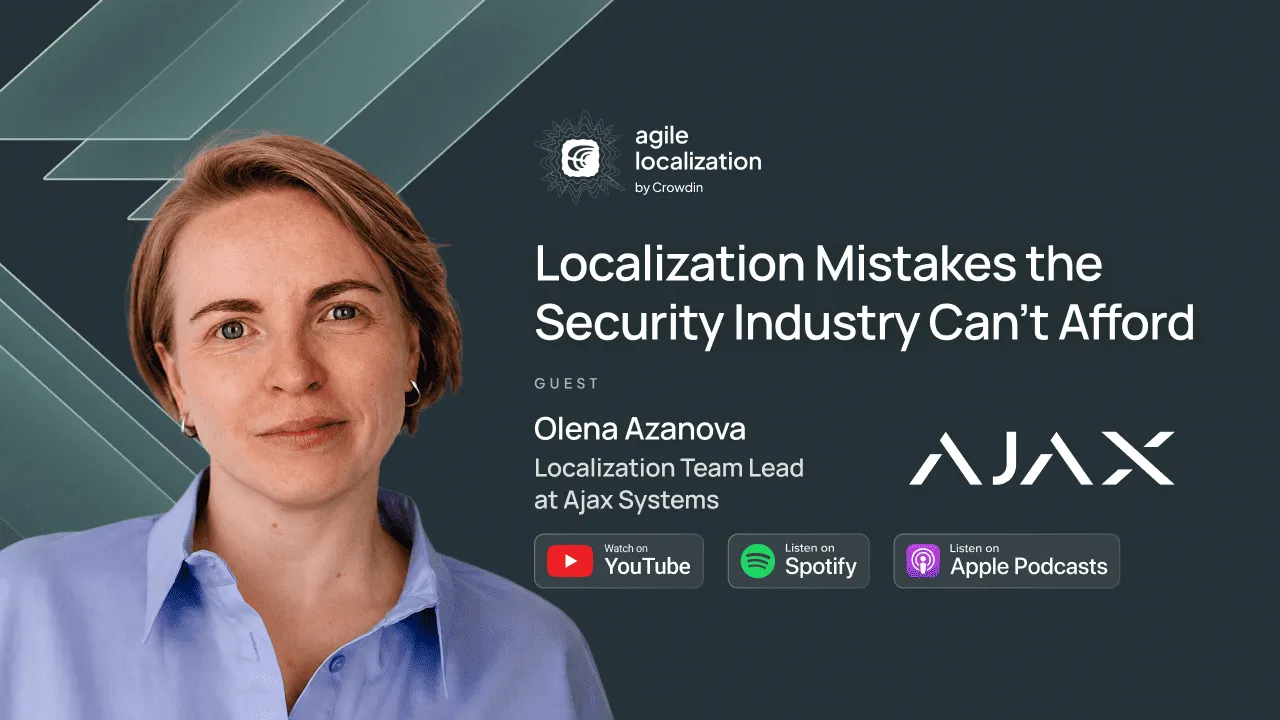
When your product protects people’s homes, families, and businesses, a translation error can shatter trust, violate regulations, or leave someone unable to use a device they depend on. That’s the reality Olena Azanova lives every day as Localization Team Lead at Ajax Systems, Europe’s largest manufacturer of security systems.
In a recent episode of The Agile Localization Podcast, host Stefan Huyghe sat down with Olena to unpack what localization really looks like when the stakes are this high and the lessons she’s learned scaling a multilingual team across more than 12 markets.
Listen to the new episode on:


Selling peace of mind
Olena made one thing clear from the start: customers aren’t buying sensors and hubs. They are buying a feeling.
"What they’re actually buying is their peace of mind. And language is a foundation of that feeling. It has to feel native. It has to feel flawless at all times.
To drive the point home, Olena shared an example from a competitor’s security system. A push notification that read: “Human body identified in garage.” Technically accurate? Sure, the sensor did its job. But imagine getting that alert at 2 AM. It reads less like a motion detection event and more like the opening line of a true crime podcast.
The system worked perfectly, but the language made it feel terrifying for all the wrong reasons.
When one character can change everything
In most industries, a small typo is a minor annoyance. In security, it can misrepresent an entire product. Olena shared a story she admits she uses to scare newcomers joining her translation team, and for good reason.
Ajax makes a fire detector called FireProtect 2 that includes a CO (carbon monoxide) sensor. During a project with an outside translation agency, a Portuguese translator typed ‘CO2 detector’ instead of ‘CO detector.’ Carbon dioxide versus carbon monoxide: one is what you exhale, the other is a deadly gas.
The team caught it before it went to print. However, Olena stressed just how close it came to shipping. On a printed brochure or a two-meter-tall banner at a trade show, that kind of mistake tells potential buyers that if you cut corners on language, you are probably cutting corners on safety too.
Another example: Ajax’s Grade 3 certification line, designed for high-risk facilities like banks and museums, was a breakthrough as the first wireless system to achieve that rating. If a translator accidentally typed Grade 2 instead of Grade 3 in a launch email, the entire announcement would lose its impact because Grade 2 systems are common.
French market won’t let you fake it
Regulatory compliance adds another layer of complexity that most localization teams never have to think about.
Olena walked through the case of the French market, where fire safety products don’t follow the broader European EN 54 standard. They operate under the stricter Type 4 fire framework. That meant Ajax couldn’t simply reuse its existing French translations.
The central device, called a hub in other product lines, had to be labeled a fire alarm central unit to meet Type 4 requirements. Using the wrong term wouldn’t just confuse customers; it would render the product legally unsellable in France.
Terminology breaks first when you scale
What cracks first as a localization operation grows? Terminology.
With 12+ stable locales receiving a constant stream of app updates, user manuals, marketing materials, and technical documentation, consistency becomes the hardest thing to maintain.
Olena pointed to the Arabic market as a case study. Ajax had been using freelancers and agency translators, but the results were inconsistent. Too many translators from different countries, too much subjectivity, no unified glossary.
The fix wasn’t to throw more translators at the problem. Instead, they hired one in-house Arabic translator, had her audit every previous translation, build a new glossary, update translation memories, and attend internal sales onboardings for Arabic-speaking markets. Only after that foundation was solid did they bring on a second translator.
Own it publicly, fix it privately
Managing a 15-person team spread across nationalities, time zones, and very different languages requires a specific kind of leadership.
Olena’s philosophy is to take responsibility. When something goes wrong, she owns it in front of other teams so her translators don’t have to justify the nuances of their language to a product owner who doesn’t understand why Arabic takes twice as long as Dutch.
"That’s my responsibility, and that’s what builds trust in the team.
Olena’s background
Olena Azanova is the Localization Team Lead at Ajax Systems, the largest manufacturer of security systems in Europe, where she oversees localization strategy across 12+ stable locales. With 15 years of experience in translation and localization, Olena has built deep expertise in managing complex, highly regulated localization workflows for hardware and software products. At Ajax, she leads a multilingual, in-house team responsible for translating everything from critical compliance documentation to user manuals, marketing materials, and audiovisual content, with zero tolerance for error across all deliverables.
The views, thoughts, and opinions expressed in this podcast are the speaker’s own and may not necessarily align with those of Crowdin.
Listen to the new episode on:

Yuliia Makarenko
Yuliia Makarenko is a marketing specialist with over a decade of experience, and she’s all about creating content that readers will love. She’s a pro at using her skills in SEO, research, and data analysis to write useful content. When she’s not diving into content creation, you can find her reading a good thriller, practicing some yoga, or simply enjoying playtime with her little one.