

The localization and language services industry is full of opportunities for various experts. But to become an expert, continuous learning is a must.
With so many available courses, how do you choose the best one? In this guide, we will cover the top courses for learning localization.
We will go over the main professions and skills required for each one and provide you with the list of the best options to help you start online learning. Let’s get started.
4 Best Courses for Localization Project Managers
If you want to become a localization project manager or develop new skills, several courses are available.
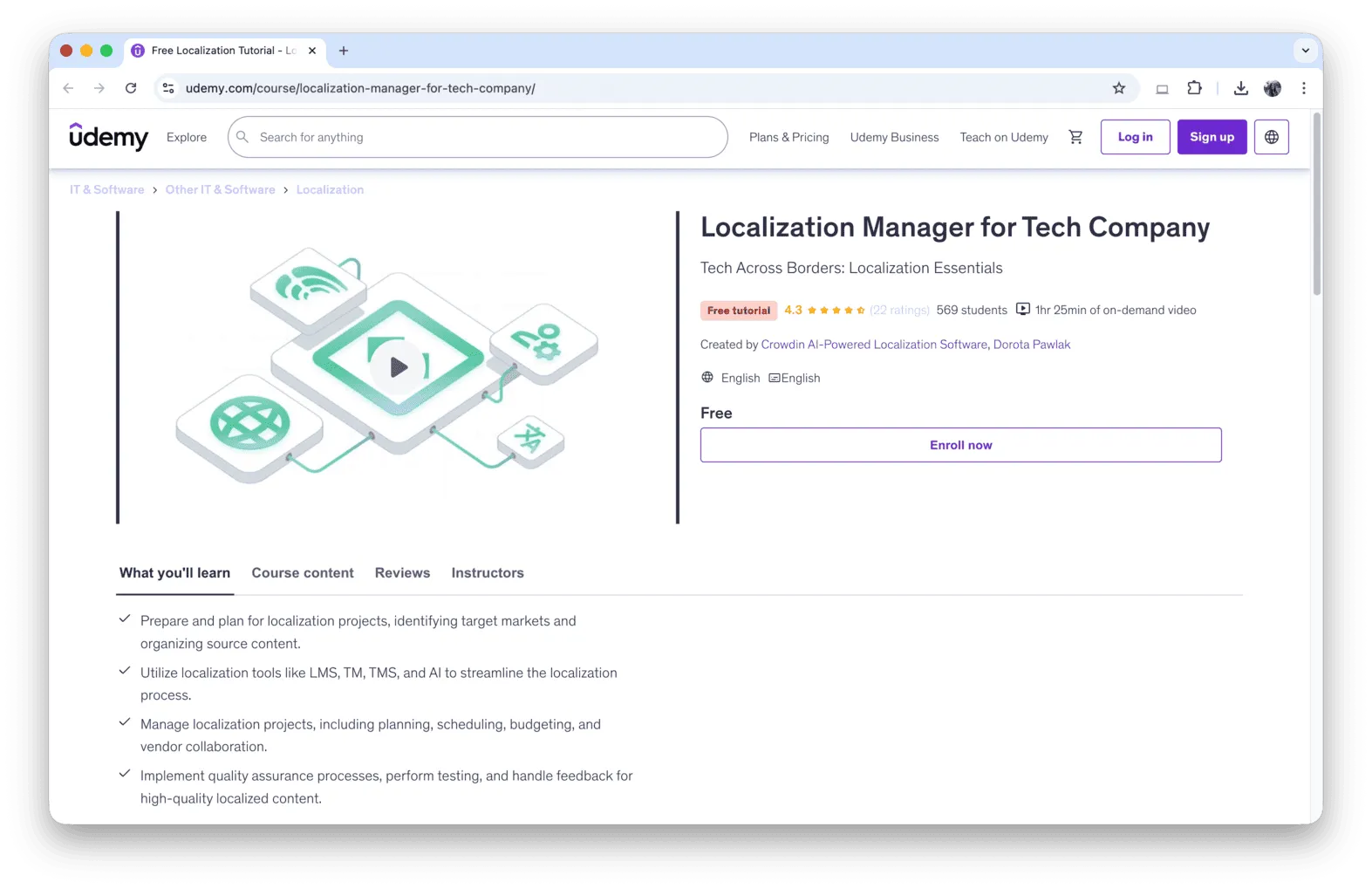
1. Localization Manager for Tech Company Course
Take a look at the online course Localization Manager for Tech Company on Udemy. This is a free program that focuses on managing core processes and optimizing expenses, tailored to this specific position. It will help you get started with the common localization tools, like LMS, TM, TMS, and AI. This makes it ideal for localization managers working in technology environments and terminology management.
2. Become a Localization Manager Course
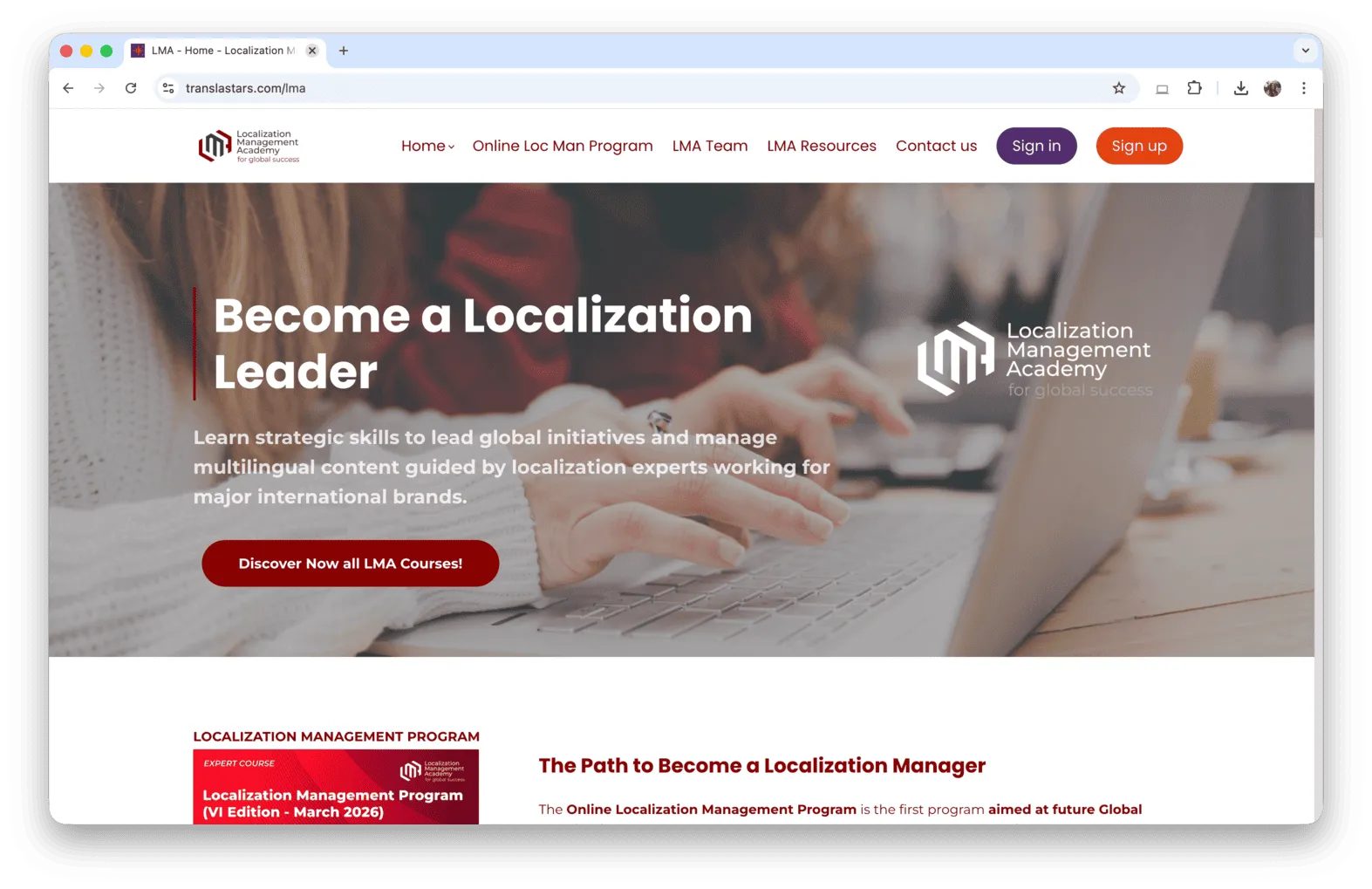
An online program by Localization Management Academy that shares a real-world, practical approach to managing localization projects. Perfect for those who are taking their first steps in localization management.
Students can learn how to manage the entire project lifecycle, from kickoff to delivery. The course includes guidance on project administration, communication with stakeholders, risk management, and budget control. These are essential skills for a Crowdin account owner who oversees multiple projects and teams. The 7th edition of this course will start in March 2026.
3. How to Set Up Your Localization Metrics Program
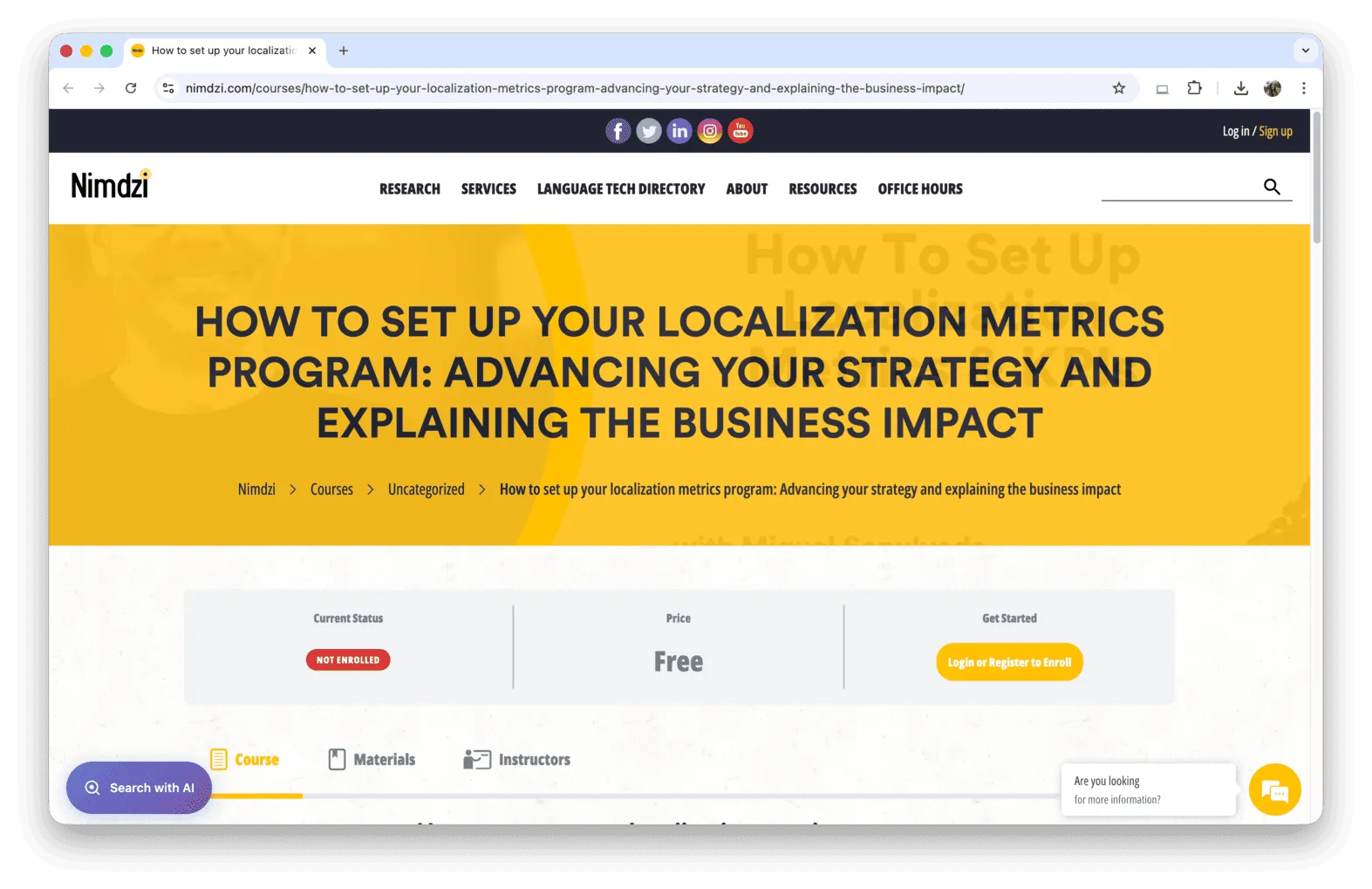
This specialized course from Nimdzi Learning is for managers who need to demonstrate the value of localization to the wider business.
From these lessons, you will learn how to define, measure, and track Localization KPIs (Key Performance Indicators), create impactful dashboards, and clearly communicate the ROI (Return on Investment) of localization efforts. This is crucial for securing budget and scaling operations.
The course offers free lessons, but the second part is for Nimdzi Partners only.
4. Account Management for Project Managers
Another course by Nimdzi Learning that equips localization PMs with the critical soft skills needed to manage relationships with clients, vendors, and internal stakeholders (such as Marketing VPs and Engineering Leads).
You will learn to conduct effective Quarterly Business Reviews (QBRs), manage professional communications, and build trust. These skills are important for prioritizing and funding localization across the organization.
Bonus: Master in AI and Innovation for Localization (Ed. IV)
Best for: Localization managers, translators, and content teams ready to move from using AI tools occasionally to running them deliberately.
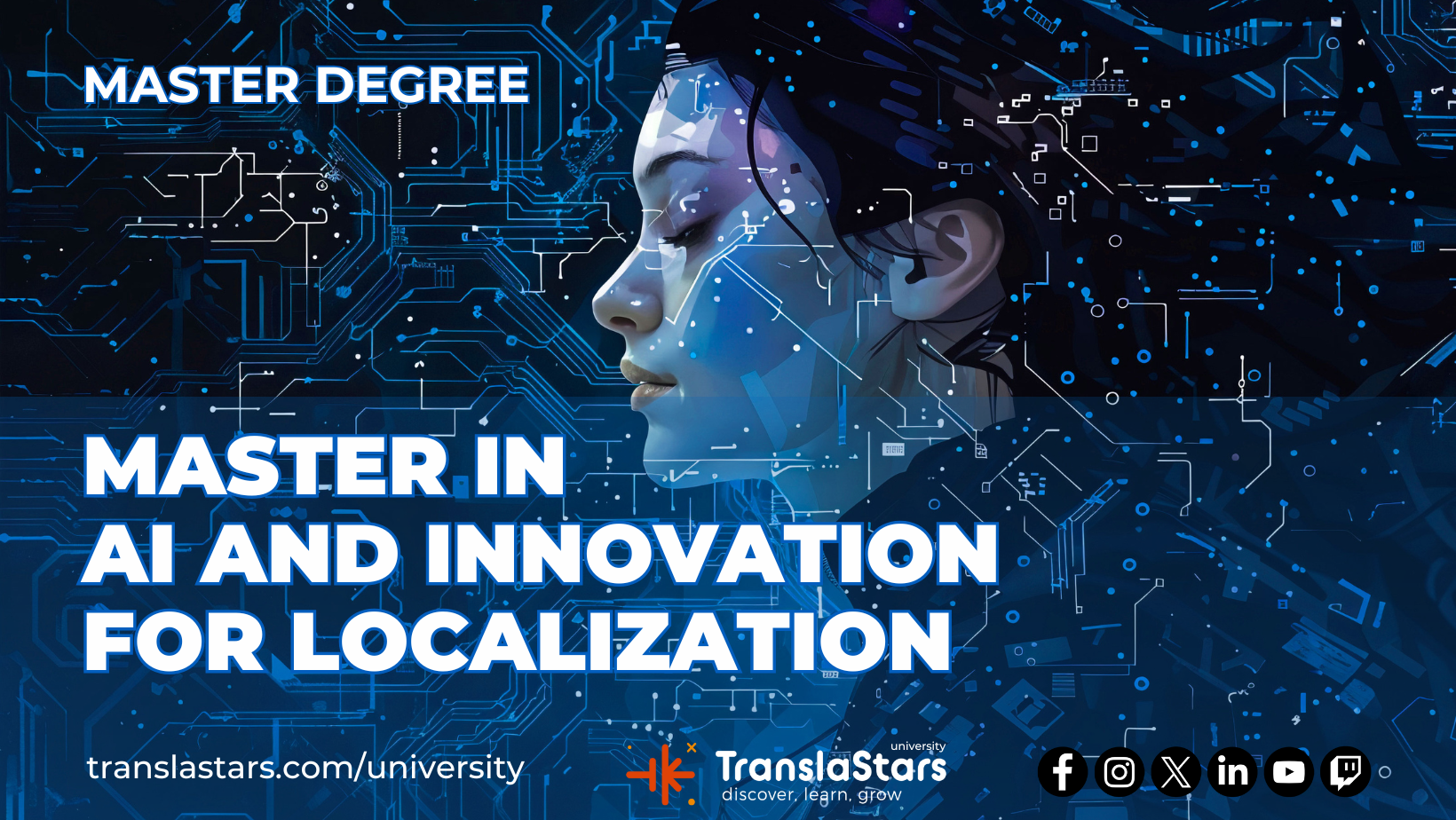
Master in AI and Innovation for Localization by TranslaStars University is a ~120-hour program covering everything from AI translation engines to AI agents, workflow automation, and AI search visibility.

The program combines 7 core modules and 9 thematic blocks, taught by practitioners from companies like DeepL, Sinch, and Undertow. You’ll evaluate AI vendors, build no-code AI agents, wire up automations, and learn how to make the business case for AI-enhanced localization workflows before rolling them out to a team.
- Duration: ~120 hours (live sessions plus on-demand recordings, no deadlines).
- Format: Fully online, delivered entirely in English.
- Key topics: AI translation engines, AI agents and automation, AI search (SEO/AEO/GEO) for multilingual content, and building the business case for AI adoption.
- Price: €450 (Early Bird until 5 October 2026, then €495).
Special Offer for Crowdin Enterprise Users
Crowdin is sponsoring this master for our Enterprise users, so you can keep building your AI skills at no cost.
If your company uses Crowdin Enterprise, you can join this program for free.
How to claim your free spot:
- Ensure you are currently employed by a company using Crowdin Enterprise (a corporate email address is required).
- Send proof of your company’s Crowdin Enterprise usage to TranslaStars.
- Once verified, you will receive access to the full program and the live sessions.
When: Starts 5 October 2026, running through mid-December 2026.
Join the Master in AI & Innovation for Localization
4 Best Courses for Localization Engineers and Developers
The localization engineers are responsible for internationalization (i18n), automation, software localization, and integrating localization tools into workflows. Such specialists are responsible for internationalization (i18n), automation, software localization, and integration of localization tools into workflows.
We listed 4 courses that offer valuable insights into the required skills.
1. Next.js i18n Course
Build international Next.js apps with confidence. This course offers video lessons on establishing i18n from a technical perspective. You will learn about the main aspects of the process and get code snippets, summaries, and tagged commits that you can later implement in your apps.
The course was created by the founder of next-intl library, who is also a university teacher in Austria. Lesson #10 covers AI localization with Crowdin. If you are developing Next.js apps, this course is worth trying!
2. i18n Course for Symfony Developers
Another useful course to pay attention to is “Bonjour-> Hello -> Hola: Translate Your Site”. There you will find valuable insights on transforming a single-language Symfony app into a multilingual platform with the use of translations. Discover various effective ways to adapt an app with overcomplicated workflows.
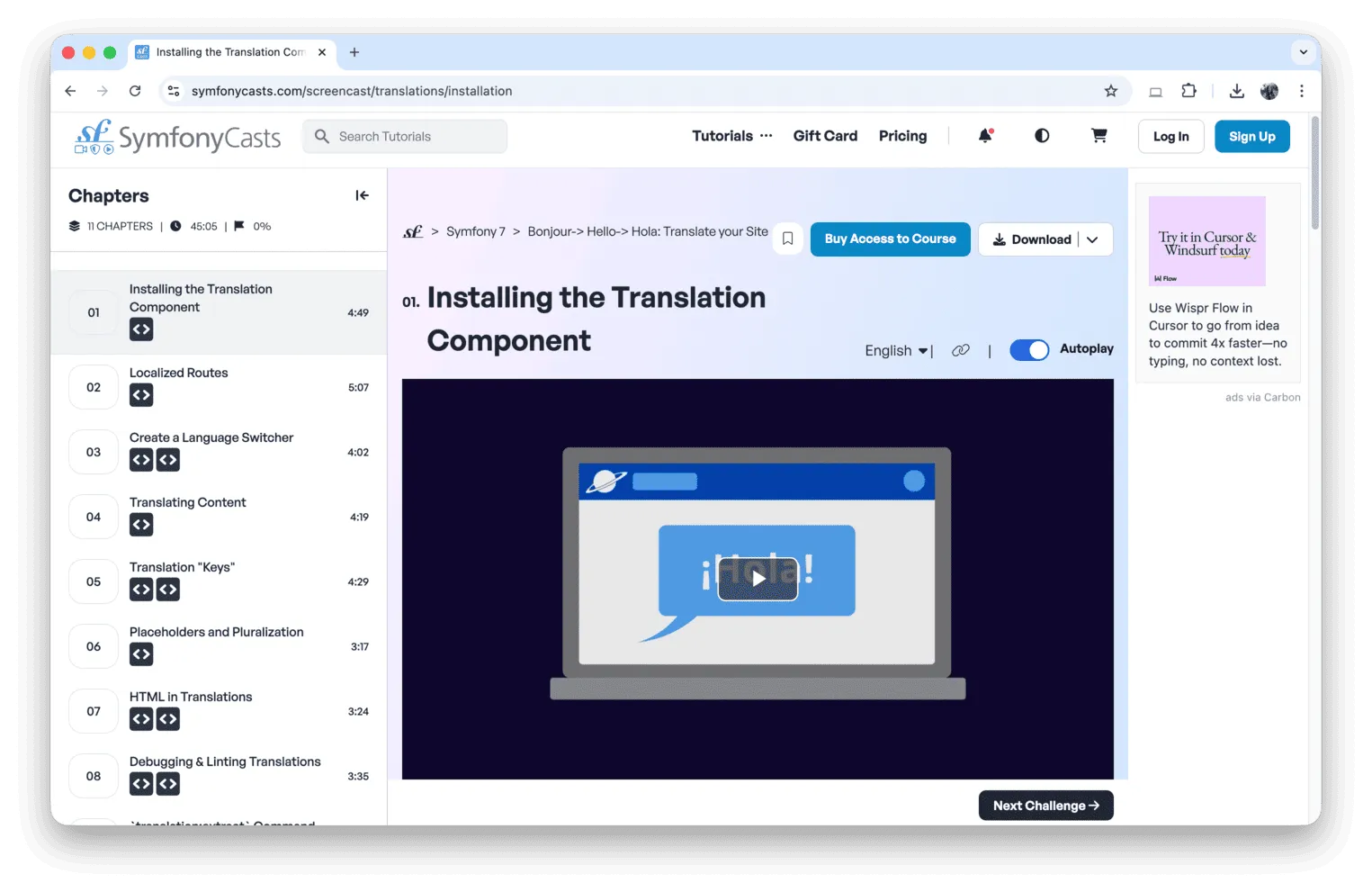
Lesson #10 shows how to connect your Symfony app to a translation provider like Crowdin.
3. Multi-language PHP: Internationalization for PHP Developers
This Udemy course is dedicated to transforming single-language PHP applications into multilingual platforms. This course is for developers who need actionable steps to implement i18n in their codebases.
You will gain core skills for modern PHP internationalization, including:
- Implementing translation systems
- Handling locale-specific data
- Managing plural forms
- Creating a language switcher
The principles taught here ensure the developer correctly extracts translatable strings into standard file formats (such as .json or .xliff), making it simple to upload them to Crowdin via the PHP SDK client, eliminating common source-code issues that block continuous localization.
4. Localize Your Websites with Crowdin by freeCodeCamp
freeCodeCamp created a free, hands-on guide for developers looking to immediately integrate localization into a website using Crowdin’s tooling. The 8-hour video guide shows all the aspects: from the implementation to connecting apps from the Crowdin Store.
You will learn the practical steps of setting up a project, integrating Crowdin with a version control system (like GitHub), and automating the synchronization of source content and translated files. It is an excellent example of implementing continuous localization from a developer’s perspective.
4 Best Courses for Linguists and Freelance Translators
Linguists bring cultural nuance and consistency to the localized content. Such specialists focus on:
- translation
- editing
- proofreading
- ensuring linguistic quality
Human translators allow us to keep the brand’s aesthetic and connect with the locals.
There are several educational courses for those interested in improving their translation and post-editing skills.
1. Crowdin for Linguists: Everything You Need to Know
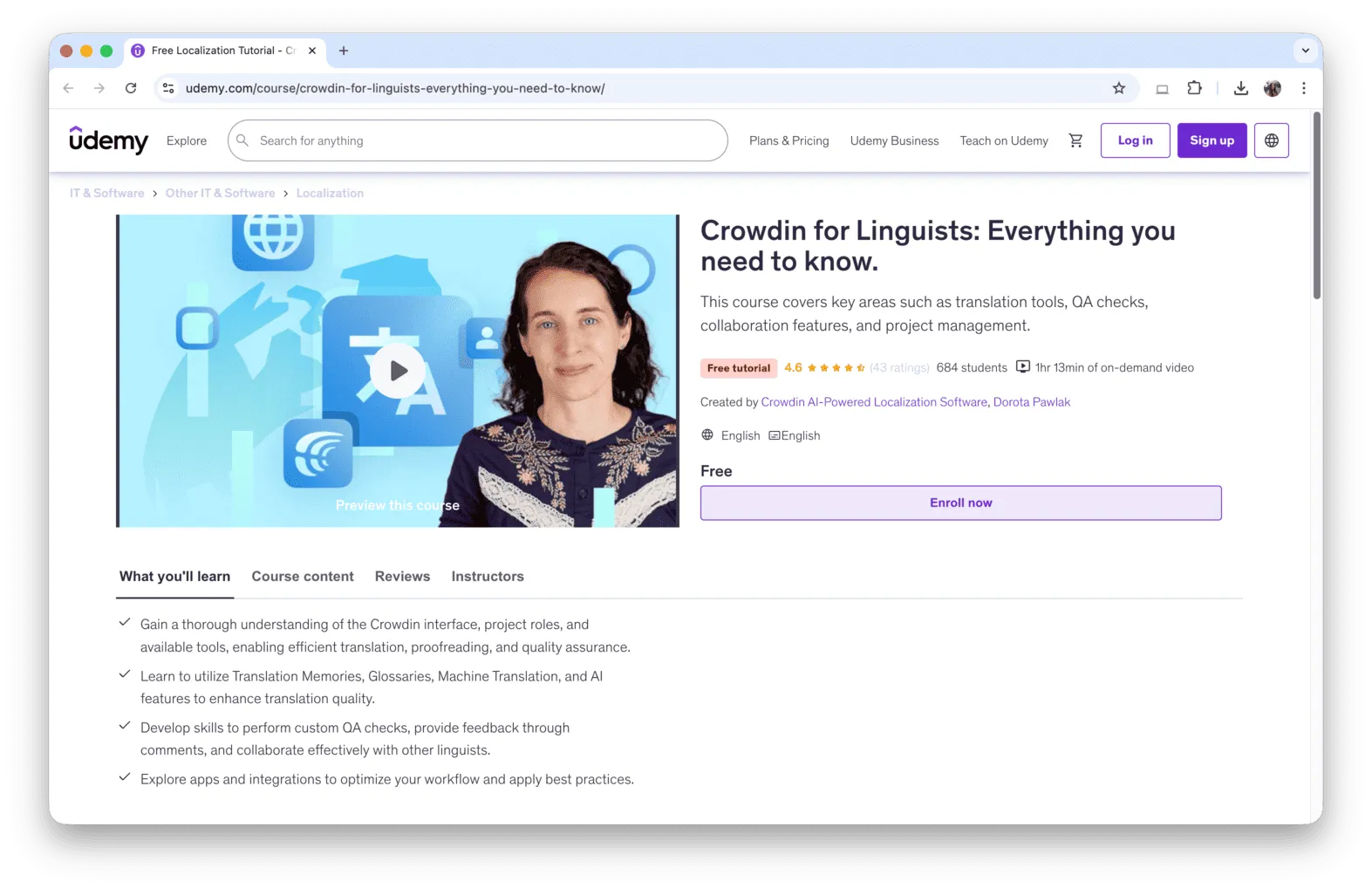
The first recommendation is “Crowdin for Linguists: Everything You Need to Know” on Udemy. There, you can learn all the main aspects of working with Crowdin. Within the course, you will learn about how linguists can implement such a tool to improve translation efficiency and quality.
2. Course on AI in Translation
Another recommendation is the course “Mastering Translation AI”. There, you can find insights into improving your translation and editing skills by implementing AI tools.
You will also learn how to utilize AI for achieving the highest percentage of ready-to-publish translations.
3. Introduction to Localization Tools for Translators
Course for beginners in localization. It teaches linguists how to manage and localize digital content by focusing on the tools and processes.
You will gain proficiency in using various Computer-Assisted Translation (CAT) tools and Translation Management Systems (TMS). The curriculum details how to efficiently localize web and mobile application projects, including translating different file formats and ensuring the consistency of digital content across platforms.
4. UX and Localization: Designing Content for Global Markets
UX and Localization by Nimdzi for those who want to deepen their knowledge. This course teaches linguists and UX writers how to align product design and content creation with global market needs and address cultural diversity. Ensure the product is design-ready for expansion before translation even begins.
How to Choose a High-Quality Online Course in Localization: A 5-Point Checklist
It can be challenging to find a course that not only provides valuable insights but can also be applied in practice. Here’s where a comprehensive structure is very helpful. It helps you to identify high-quality courses that can enhance your professional expertise.
1. Look for Practical Training
Make sure that there is a practical curriculum within the training. It should include hands-on training with comprehensive software and real-life examples. This approach enables you to apply theoretical knowledge to practice, thereby enhancing your overall learning experience.
2. Check Instructor’s Experience
Look for courses taught by experienced instructors who can aid in your understanding of the learning material. Search for a proven track record in the localization industry. Such specialists can provide valuable guidance through their insights and expertise.
3. Look for Quality Certifications
Third, industry-recognized certifications are crucial in various industries. Importantly, they not only validate your skills but also make you more attractive to potential employers.
4. Access to Modern Tools
Hands-on tool training is essential. Ensure that the course provides comprehensive training on the latest localization tools and technologies.
5. Student Reviews
Positive student reviews can offer insights into the course’s effectiveness and the quality of instruction. Look for testimonials and reviews from past students to gauge their experiences and expectations.
Beyond the Certificate: How to Land Your First Job in Localization
Continuous learning and receiving certification play a huge role in landing your first job in the localization industry. However, a certificate is only one of many things the companies will be searching for.
To improve your attractiveness as a potential employee, you must also work on:
- building a strong portfolio
- networking
- gaining real-world experience
The first step is creating a portfolio. List all your skills and projects you have worked on. One of the most beneficial aspects is including examples of your work. It includes snippets of localized content, translation projects, and any other relevant project involvement.
To establish a professional network, LinkedIn is the go-to platform. You can not only search for opportunities but also build valuable industry connections. Attend online and offline events created by LocLunch to find more connections.
Getting experience is probably the hardest and most important part. You can contribute to open-source projects. Additionally, communicate with the course instructor about the potential practice and look for resources that offer experience programs.
Helpful Tips
If you don’t know where to start the search for the course and how to get the most out of the investment, follow our five-point checklist. Also, remember that a certificate is only one part of a successful job application.
Create a portfolio, work on your networking, and gain experience every chance you get. Your journey into the world of localization starts now, so take the first step and enroll in a course that aligns with your career goals.
Conclusion: Your Journey into Localization Starts Now
The localization industry is becoming more and more in demand by businesses with the voluntarily growing globalization tendency. Whether you are interested in global marketing, software localization, machine translation, project management, or other language services, there are a lot of opportunities in this field.

Explore Localization Resources
Get industry insights and practical tips. We prepared webinars, e-books, free courses, podcast episodes, and other content for you.
Check it OutFAQ
What is an example of a localization course?
One of the best examples is “Crowdin for Linguists: Everything You Need to Know” on Udemy. It provides valuable insight into using a localization tool like Crowdin, which is essential for optimizing localization processes.
How to break into localization?
To enter the localization field, engage in relevant coursework, create a strong portfolio, and actively network on platforms like LinkedIn.
What does a localization specialist do?
A localization specialist works on adapting content for a specific foreign market. It includes software adjustment, language translation, and quality assurance of the content.
What should I look for in a high-quality localization course?
In a high-quality localization course, prioritize a practical curriculum, experienced instructors, industry-recognized certification, hands-on tool training, and positive student feedback to ensure a valuable learning experience.
How can I gain real-world experience in localization?
To gain real-world experience in localization, start working on building your professional network. By connecting with other specialists, including instructors and other course participants, you can find open-source projects and other opportunities.

Yuliia Makarenko
Yuliia Makarenko is a marketing specialist with over a decade of experience, and she’s all about creating content that readers will love. She’s a pro at using her skills in SEO, research, and data analysis to write useful content. When she’s not diving into content creation, you can find her reading a good thriller, practicing some yoga, or simply enjoying playtime with her little one.