

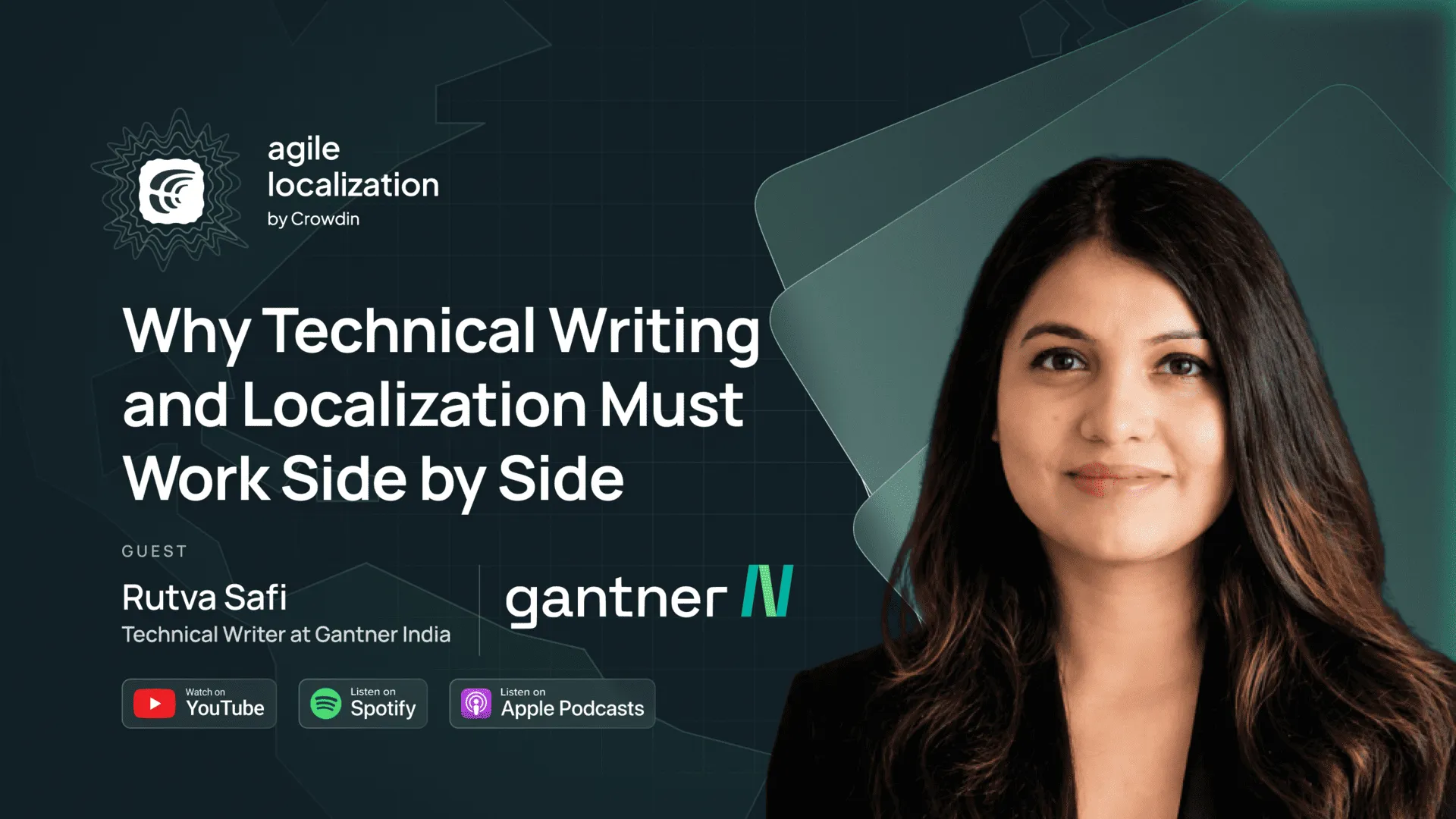
When we think about shipping a product, documentation often gets treated like an afterthought, something tacked on right before the release, or worse, weeks after it. But what if the docs are the product? And what if the moment you start writing them is already too late for localization?
In a recent episode of The Agile Localization Podcast, host Stefan Huyghe sat down with Rutva Safi, Senior Technical Writer at Gantner India, to explore exactly this. Rutva brings a unique lens to the conversation. With over eleven years in IT, spanning roles from developer to business analyst, quality analyst, and even law, before finding her true calling in documentation.
Listen to the new episode on:


Documentation is the product
"Documentation is never support material. It has always been part of the product from day one.
Rutva backs this up with a wonderfully relatable personal story about ordering a home camera to keep an eye on her dog. When she opened the box, there was a quick guide inside: short instructions, a QR code to download the app, and a clear path from unboxing to setup.
As a technical writer, she couldn’t help but appreciate how that tiny piece of documentation was inseparable from the product experience itself. But it’s not just about post-purchase guides. Rutva points out that even in the pre-release phase, customers often evaluate API documentation to decide whether a product is worth investing in. Documentation shapes buying decisions long before anyone opens a box. It’s woven into every stage of the product lifecycle.
When hardware meets software, documentation becomes the single source of truth
Things get especially interesting when products involve both hardware and software components. Rutva explains that good documentation in these complex systems acts as the single source of truth for compatibility, versioning, and feature dependencies. It’s not enough to tell a user, “Update your firmware”.
A solid document specifies which software version works with which hardware model number, ensuring users aren’t left guessing about compatibility. Without that clarity, you’re practically guaranteeing support tickets.
Features vs. workflows
One of the standout insights from the conversation is Rutva’s distinction between documenting features and documenting workflows.
"Documenting features is like describing an individual piece of a puzzle. Workflows are about putting all those pieces together.
A feature doc might explain what user authentication does. A workflow doc walks the user through logging in, entering credentials, handling failed attempts, understanding permissions, and recovering access. It’s the difference between a dictionary entry and a story, and users need the story.
The language gap
Rutva offers a sharp observation about internal miscommunication:
- Engineers speak the language of system logic (How does the engine run?)
- Product managers speak the language of business value (Why was the car built?)
- Users speak the language of tasks (How do I drive to the store?)
The technical writer’s job is to translate across all three: simplifying system logic, distilling business value, and delivering it in a layman’s language that real users can act on. As Rutva puts it, “Assumption is the mother of all miscommunications”.
Translation vs. localization
Perhaps the biggest mistake Rutva sees teams make is treating translation and localization as the same thing. Translation is converting words from one language to another. Localization goes deeper: it accounts for tone, context, and cultural sensitivity.
A phrase like “burning platform”, which means an urgent situation forcing rapid change in English, means absolutely nothing in German or Japanese. Dates like 01/02/2026 could mean January 2nd or February 1st, depending on your region.
Rutva’s practical tips for writing localization-ready content include avoiding idioms and cultural references and keeping sentences short with one idea each. These habits simplify the technical documentation localization process by limiting each instruction step to a single action and ensuring date, time, and number formats are always clarified.
Side by side from day one
Technical writers and translators need to be in the room from the very beginning. At Gantner, Rutva works in parallel with developers, attending grooming meetings, asking questions about features, and flagging UI inconsistencies, mislabeled buttons, and unclear warning messages.
The same parallel workflow extends to localization through Crowdin, where terminology glossaries and translation processes run alongside documentation from day one. As a result, when a product ships, the documentation is ready in every target language.
"When technical writing and localization go side by side, you have the final product, and along with it, documents in all the languages you can deliver to customers globally when the product is released. That itself makes the product better.
Rutva’s background
Rutva Safi is a Senior Technical Writer at Gantner India with over 11 years of experience in the IT industry, complemented by expertise as a Google Certified Digital Marketer and practicing lawyer. Her diverse background, spanning roles as a developer, business analyst, and quality analyst, uniquely positions her to bridge the gap between engineering complexity and user comprehension.
The views, thoughts, and opinions expressed in this podcast are the speaker’s own and may not necessarily align with those of Crowdin.
Listen to the new episode on:

Yuliia Makarenko
Yuliia Makarenko is a marketing specialist with over a decade of experience, and she’s all about creating content that readers will love. She’s a pro at using her skills in SEO, research, and data analysis to write useful content. When she’s not diving into content creation, you can find her reading a good thriller, practicing some yoga, or simply enjoying playtime with her little one.