

Nowadays, AI localization is an art that requires more than just linguistic knowledge. As AI becomes an integral part of the localization workflow, mastering the art of crafting effective prompts is important for translators and localization professionals.
This article was created in collaboration with professional linguist, localization consultant, and AI trainer Dorota Pawlak.
Find out advanced prompting strategies and examples for using Agentic AI in Crowdin to enhance various aspects of the localization process.
Why Advanced Prompts Matter
Advanced prompts function as a mini-program, instructing the AI what it should do step-by-step. An effective prompt allows the Agentic AI in Crowdin to perform complex tasks, such as generating a pre-translation, checking it against a glossary, and producing output that matches a specific brand style guide.
What will happen if you use not-so-advanced prompts? You will certainly receive an answer from the Agentic AI. However, you will need to create more and more iterations to achieve the desired result. By getting your prompts right the first time, you’ll:
- Spend less time editing.
- Save money on token usage.
- Get higher-quality results.
Crowdin provides 50 free Agentic AI messages per month, go and try our prompts on practice!
We’ve prepared some use cases and prompt examples that you can use during your work.
Use Case 1: Adjusting Tone and Style
Case: You’ve got a batch of translations for a new mobile app, and the style guide says the tone should be super friendly and approachable. The initial translations are too formal, so you need to adjust them to sound more natural and conversational for users.
The Challenge: A brand’s voice is one of its most valuable assets, but it can get lost in translation. When localizing for a new market, you need to ensure the text sounds natural and reflects the desired tone, whether it’s friendly, formal, or witty.
The Solution: Use a persona-based prompt to tell the AI who it should be. By giving it a specific role, you can influence its style and approach to the translation.
Instead of typing a request like this:
Make French translations friendlier.
Use an advanced, persona-based prompt:
## Purpose
## You are a **professional copywriter** for a tech startup, specializing in creating clear, friendly, and engaging user-facing documentation. You are tasked with rewriting a translation to align with our brand's voice.
## Instructions
- **Target Audience:** The rewritten translation should be tailored for tech-savvy users aged 25-45 who value efficiency and prefer direct, transparent communication.
- **Brand Voice:** The tone should be informal, helpful, and optimistic. Use language that suggests ease of use and avoids corporate buzzwords. Aim for a feeling of speaking to a knowledgeable friend.
- **Tone Examples:** Use the following sentences as examples of the desired tone and style:  - _Instead of:_ "Access the configuration panel."  - _Use:_ "Dive into your settings!"  - _Instead of:_ "Users are advised to proceed with the update."  - _Use:_ "Ready for the new features? Go ahead and update!"
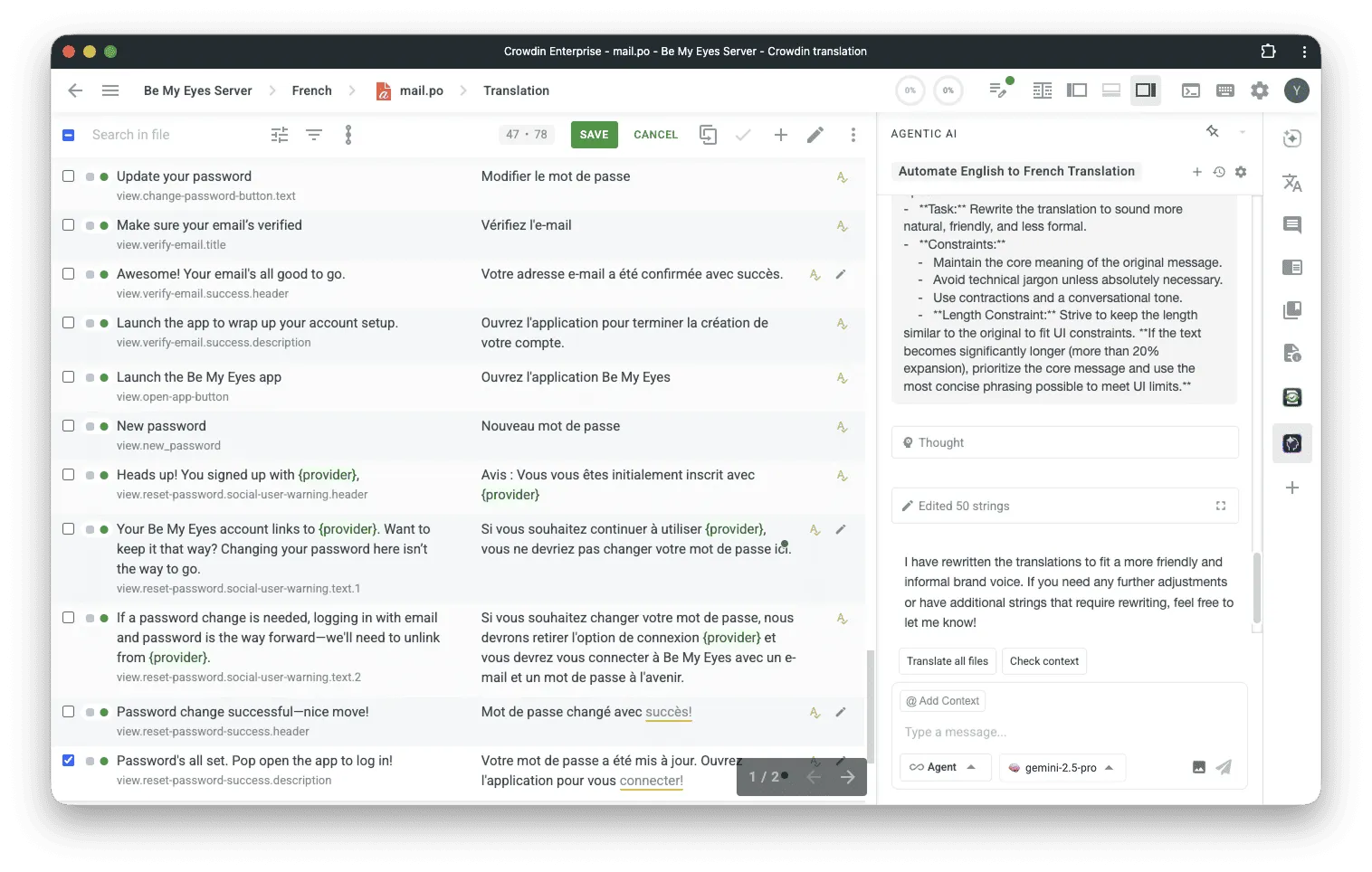
- **Task:** Rewrite the translation to sound more natural, friendly, and less formal.
- **Constraints:**  - Maintain the core meaning of the original message.  - Avoid technical jargon unless absolutely necessary.  - Use contractions and a conversational tone.  - **Length Constraint:** Strive to keep the length similar to the original to fit UI constraints.    **If the text becomes significantly longer (more than 20% expansion), prioritize the core message and use the most concise phrasing possible to meet UI limits.**
We tested this prompt in the Agentic AI chat:
Use Case 2: Adjusting String Length
Case: The translated text for a push notification is too long, causing it to be truncated on users’ mobile lock screens and potentially losing the call-to-action. You need to shorten a batch of these translations to fit the maximum system character limit without losing the core message.
The Challenge: UI design is strict. Longer translations can break layouts, so text must fit limits without losing meaning.
The Solution: Use a constrained prompt to set clear, quantitative limits for the AI. This is essential for tasks heavily impacted by design limitations.
Instead of using a vague prompt that gives no direction:
Shorten these Spanish translations so they're not so long.
Use a specific, constrained prompt with a clear target:
## Purpose
## You are a **UX localization specialist** responsible for ensuring translated UI strings fit within design constraints. Your goal is to shorten the provided translations that are too long without losing essential meaning.
## Instructions
- **Task:** Shorten the translation to fit a specified character limit.
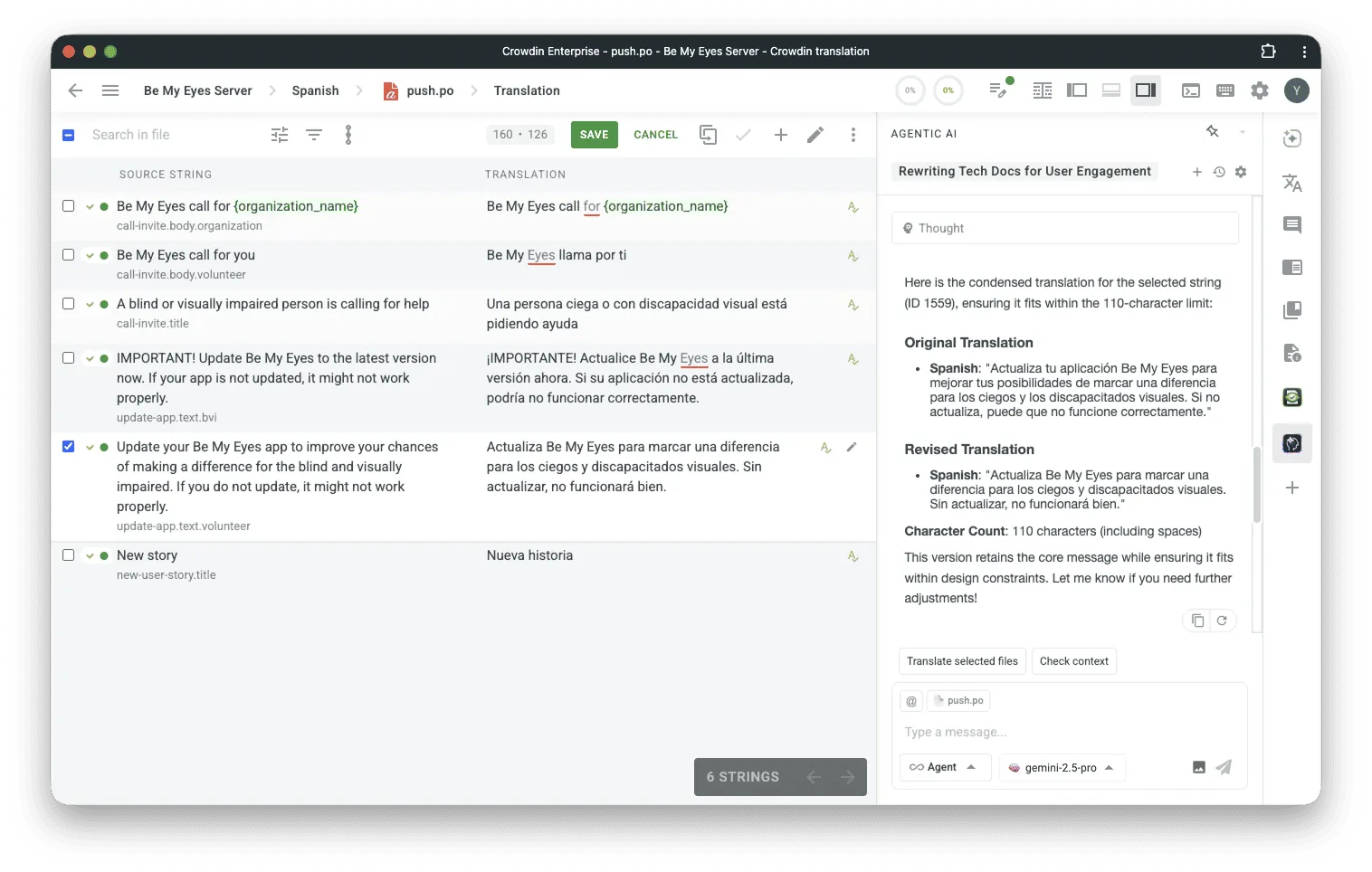
- **Constraints:**  - **Maximum Character Limit:** 110 characters (including spaces).  - **Priority:** Retain core meaning, even if it requires a more concise or slightly rephrased message.  - **Language:** Maintain professional and clear language.
Agentic AI in Crowdin will detect translations that are longer than 110 characters and rewrite them according to your instructions.

Use Case 3: Localizing for SEO
Case: You’re localizing an SEO blog post about “human vs AI translations” for the Spanish market. A direct translation might be “Traducción humana vs. IA”, but you need to know if that’s what native speakers actually search for.
The Challenge: A direct translation of a keyword might not be what users are searching for in a new market. A translator needs to find the most relevant, high-traffic search terms in the target language to ensure content is discoverable.
The Solution: Combine a persona with specific constraints to perform a specialized SEO audit.
Instead of a generic prompt that lacks context and constraints:
Translate my keywords for Spanish.
Use an advanced prompt that defines the AI’s role and the desired output:
## Purpose
## You are a **marketing specialist** with expertise in search engine optimization (SEO) for the **%targetLanguage%** market. You are tasked with localizing a set of keywords to ensure they are relevant and have high search volume in the target locale.
## Instructions
- **Source:** You will receive a list of source keywords.- **Task:** For each source keyword, generate a set of equivalent, high-potential terms in **%targetLanguage%**.- **Keyword Categories and Volume:** You must provide keywords based on the following monthly search volume ranges:  - **High-Volume Keywords:** Generate the **top 3 most relevant terms** with a **minimum of 1000 monthly searches**.  - **Low-to-Mid-Range Keywords:** Generate **3 additional relevant terms** with search volumes between **100 and 1000 monthly searches**.- **Constraints:**  - **Data Requirement:** For every generated keyword, you must include its estimated monthly search volume to indicate its rank.  - **Format:** Present the results in two separate, clearly labeled bulleted lists for each keyword category.  - Ensure the tone is natural and reflects a user's search query.  - Include the source keyword as a reference for each localized list.
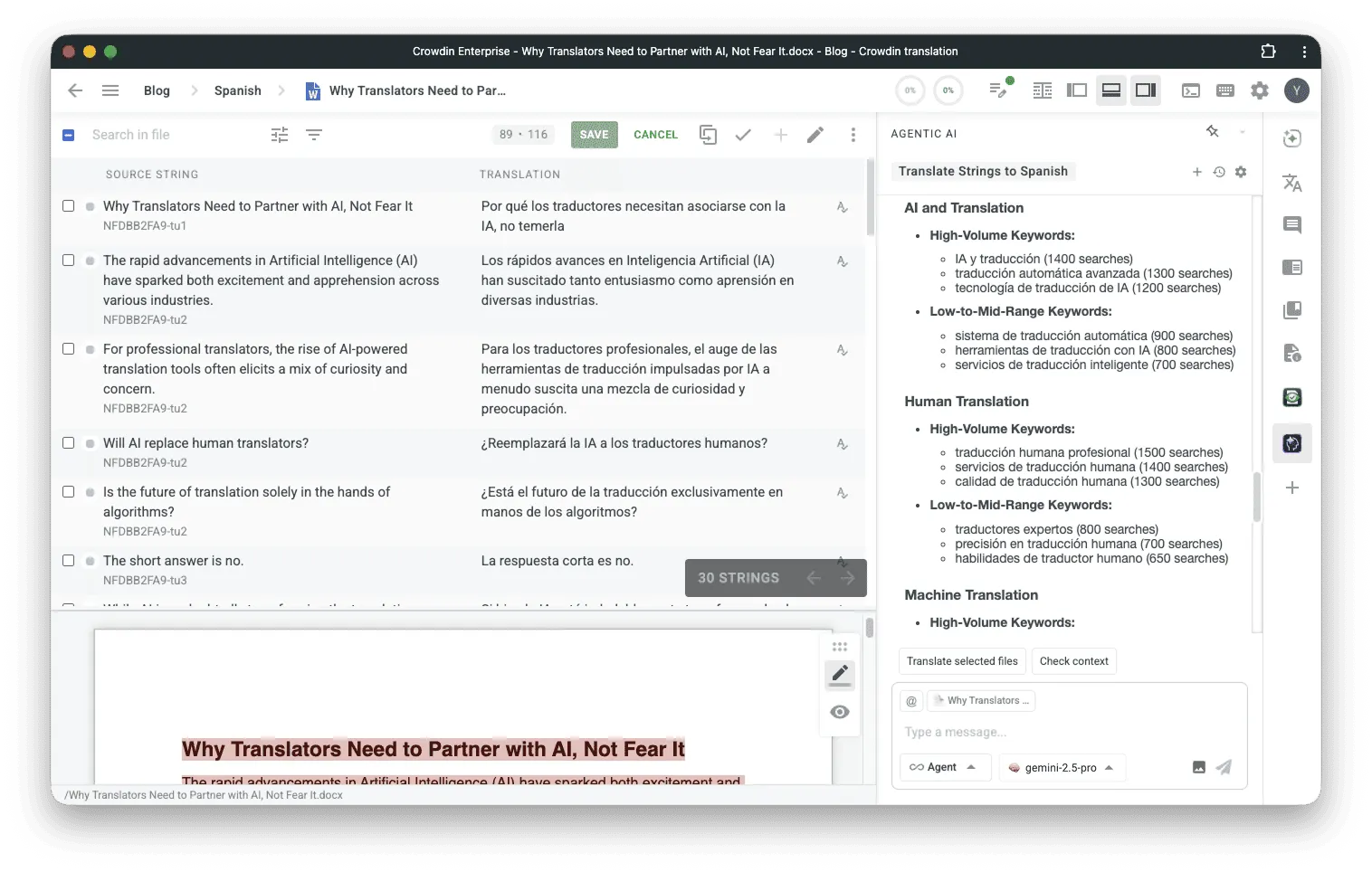
And here is the Agentic AI’s output of keywords localized to Spanish, along with the number of monthly searches, sorted from high-volume to low-volume.
Use Case 4: Comprehensive QA and Error Correction
Case: You’ve received a large file of translated strings that needs a final quality check before they go live. Instead of manually reviewing each one for a variety of potential errors, you want to use an AI to perform a comprehensive audit and flag any issues related to accuracy, fluency, terminology, and locale conventions.
The Challenge: Manually reviewing hundreds or thousands of strings for multiple types of errors – like accuracy, grammar, or inconsistent terminology – is a time-consuming and often repetitive process.
The Solution: Break down the complex QA task into a series of smaller, verifiable steps. This multi-step approach allows the AI to perform a detailed audit and report on specific issues.
Instead of a single command like this:
Check my translation for errors.
## Purpose
## You are an **AI quality assurance (QA) agent** for translations. Your purpose is to meticulously review a provided translation against a series of linguistic and technical criteria. You must identify and correct any errors found.
## Evaluation Criteria
1. **Accuracy Check:** Compare the translation against the source. Are there any omissions, additions, or mistranslations?2. **Fluency & Grammar:** Is the translation grammatically correct, natural-sounding, and free of typos?3. **Terminology Consistency:** Does the translation use the correct and consistent terminology? (Assume a termbase is in place).4. **Locale Conventions:** Are all numbers, dates, currency, and address formats correct for the target locale?5. **Contextual Appropriateness:** Does the translation fit the context of the product/UI? Does it use the correct tone and voice? Assume style guide and required tone/voice details are provided in the input.
---
## Instructions
- **Task:** Analyze the provided translation based on the **provided source** using the **Evaluation Criteria** above.- **Process:**  - For each criterion, identify if an issue exists.  - If an issue is found, describe the problem clearly.  - Provide a corrected version of the translation.
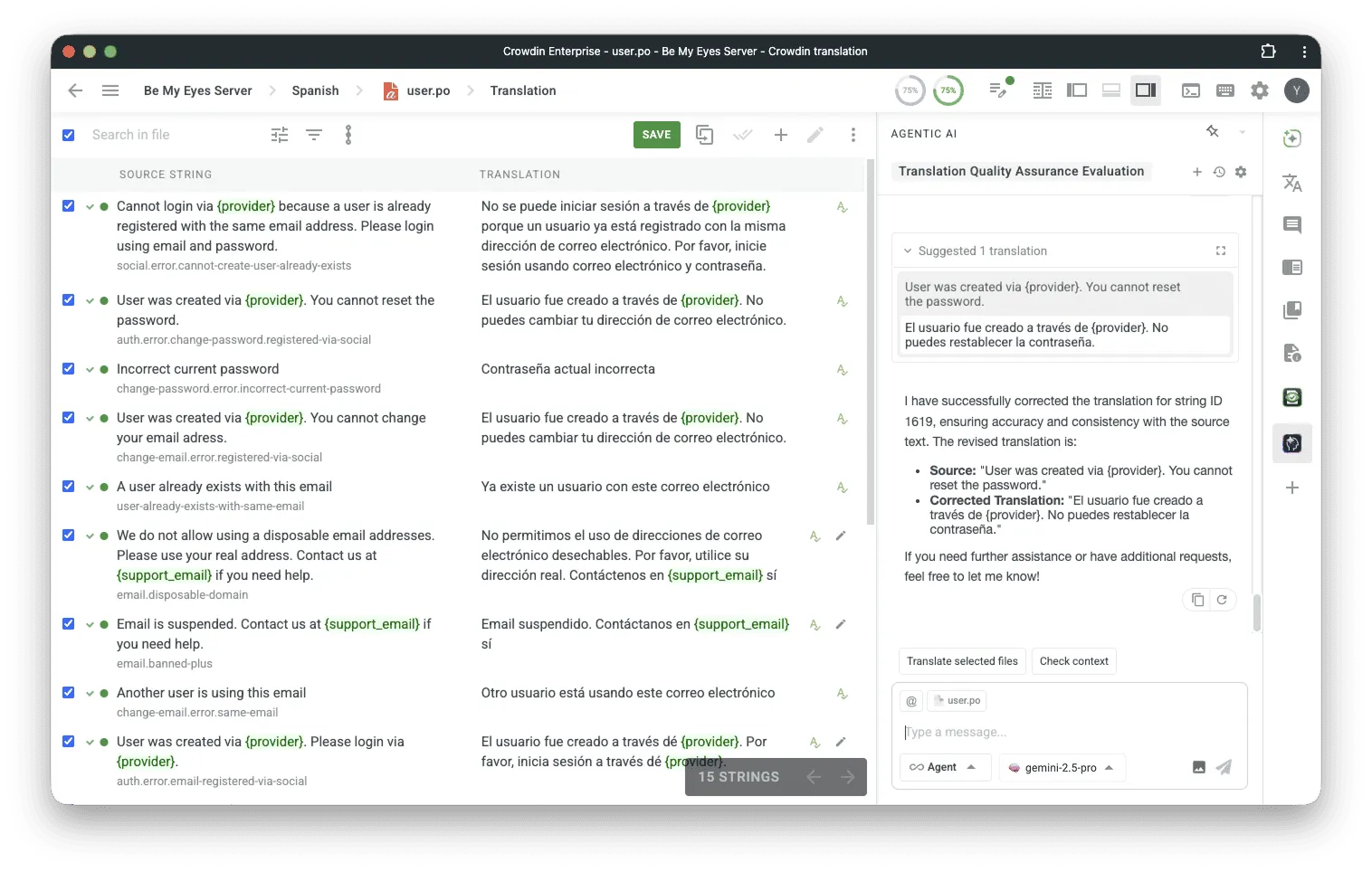
And here’s the output of the Agentic AI:
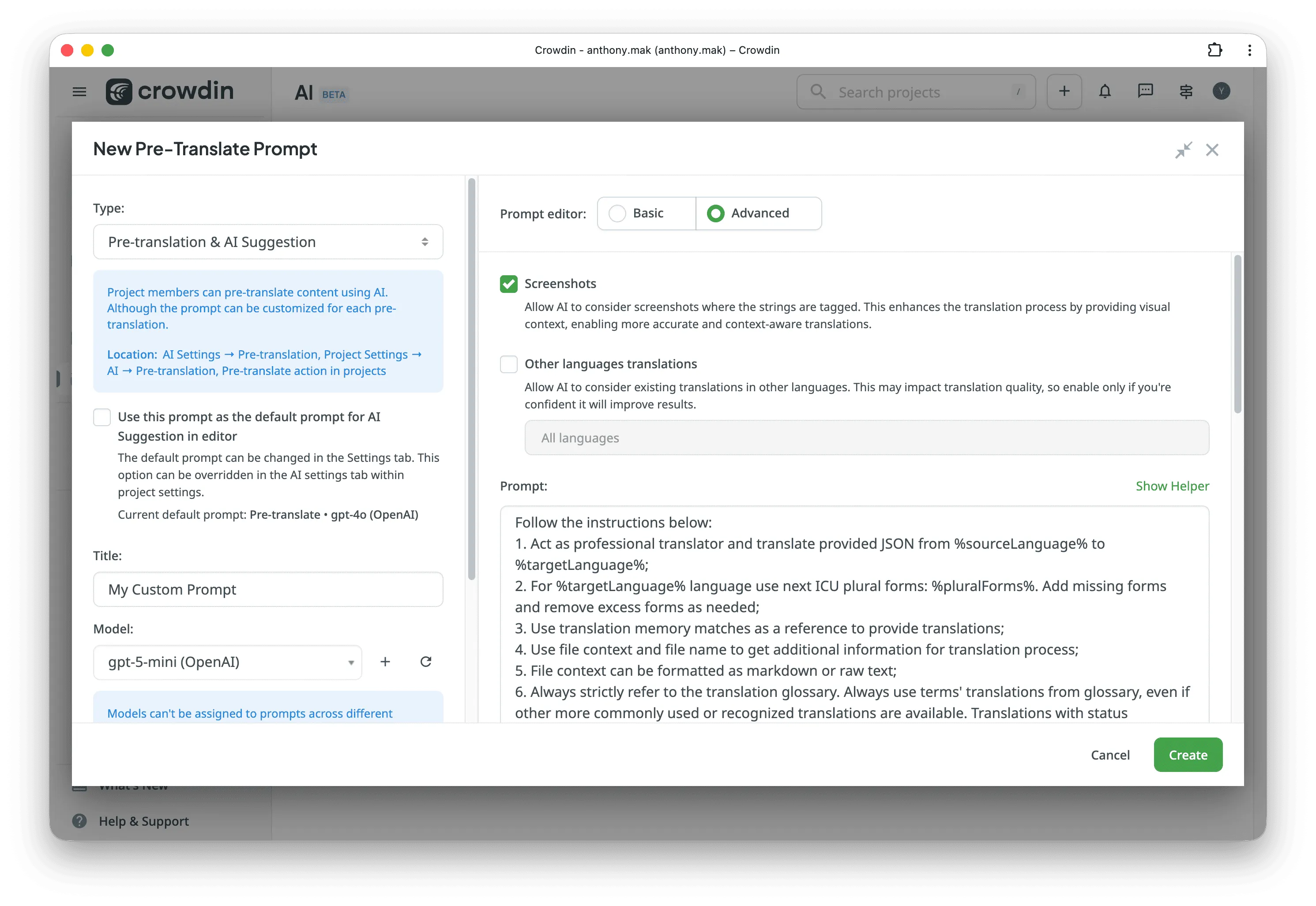
AI Pre-translate Prompts in Crowdin
Crowdin includes an AI Pre-translate feature that uses LLMs to process content initially. It has a powerful default prompt, but consider it a starting point. To achieve great results, we recommend editing and refining these instructions to match your localization needs.
Conclusion: From Translators to Prompt Engineers
The future of localization involves a hybrid of human expertise and AI efficiency. By mastering advanced prompts, localization professionals can transition from being just translators to becoming prompt engineers and directing AI to perform complex, high-quality work. This allows humans to focus on the strategic, creative, and culturally sensitive aspects of localization, while AI handles the repetitive, rule-based tasks with speed and precision.
The ability to write an effective prompt is now as essential as a deep understanding of grammar and culture.
Useful links
- How to Master Context, Tone, and Text Lengths with Crowdin’s Agentic AI
- What is Agentic AI and How Does it Change the Localization Process
- A Deep Dive into Crowdin’s Advanced Features with AI Expert Dorota Pawlak
- Best LLMs for Translation
- Mastering Translation AI Course
Localize your product with Crowdin

Yuliia Makarenko
Yuliia Makarenko is a marketing specialist with over a decade of experience, and she’s all about creating content that readers will love. She’s a pro at using her skills in SEO, research, and data analysis to write useful content. When she’s not diving into content creation, you can find her reading a good thriller, practicing some yoga, or simply enjoying playtime with her little one.