

Multilingual websites are no longer optional. For most organizations, expanding into new markets means delivering content in multiple languages from day one. The initial focus is often on translation, getting content into new languages as quickly as possible.
That approach works at first. But as content volume grows and more teams get involved, problems begin to surface. Updates fall out of sync, messaging diverges, and workflows slow down. What starts as a translation task quickly becomes a governance challenge.
In this article, we explore why content governance is essential for multilingual websites, the operational challenges global teams face, and how efficient localization workflows improve multilingual content management.
Why multilingual websites require strong content governance
When organizations operate across multiple markets, content is no longer owned by a single team. Instead, it becomes a shared system involving product, marketing, and regional stakeholders.
Without governance, that system fragments.
Multiple markets introduce operational complexity
As soon as content spans regions, coordination becomes harder. Teams work at different speeds, priorities shift by market, and visibility decreases across the organization.
Common issues appear quickly: inconsistent messaging, duplicated content, unclear ownership, and delays in publishing updates across languages.
Consider a simple product update. It goes live in English, but takes weeks to appear in other markets. During that time, customers receive different information depending on their language. The issue here is the absence of a governed process.
Content duplication becomes a scaling problem
Many traditional CMS platforms rely on page-level translation. Each language version exists as a separate entry, often disconnected from the original.
This leads to duplicated content structures and an increasing risk of inconsistencies. Every update must be repeated manually across languages. Over time, teams lose track of which version is current, and global messaging starts to drift.
What begins as a manageable system becomes difficult to maintain at scale.
Maintaining brand consistency across languages
Brand voice does not stop at translation. It must remain consistent across every market, even as content is localized.
Without governance, regional teams often rewrite content independently. Terminology varies, tone shifts, and campaigns lose cohesion. The brand becomes fragmented across languages.
Governance provides the structure needed to prevent this. It ensures consistent terminology, aligned messaging, and controlled publishing processes across all markets.
Key elements of effective multilingual content governance
To manage multilingual content at scale, governance must be built into the content infrastructure. It cannot rely on manual coordination alone.
1. Structured content models
Structured content organizes content in a modular way. Instead of duplicating entire pages, teams work with reusable components.
This approach creates consistent content structures across all locales. Product descriptions, feature lists, and pricing blocks can be reused without duplication. Updates are applied once and reflected everywhere. Learn more in our comprehensive guide to content modeling in CMS localization to see how to build reusable components.
2. Clear editorial workflows
Localization involves multiple stakeholders, each responsible for a different stage of the process. Without defined workflows, delays and miscommunication are inevitable.
Effective governance requires clear processes for content creation, translation, review, and publishing. Role-based access ensures that responsibilities are well defined, while staged workflows introduce necessary checkpoints before content goes live.
3. Locale-based publishing control
Global launches rarely happen simultaneously across all markets. Some regions move faster than others, depending on business priorities and translation readiness.
Locale-based publishing allows teams to release content in priority markets first, while continuing work on other languages. Each locale can be published independently, without disrupting the overall content structure.
Multilingual content governance model
Define roles & responsibilities
- Content strategist
- Localization manager
- Global & regional teams
- Subject matter experts
Define master content model
- Structured content (schema)
- Create reusable components
- Define multilingual fields
Create source content
- Authoring content
- Optimize for localization
- Initial SEO setup
Implement localization workflow
- Push to localization platform (Crowdin)
- AI pre-translation and automation
- Human review and transcreation
Create content policies
- Global brand guidelines
- Style guides
- Multilingual glossaries
Ensure compliance
- Automated Quality Assurance (QA)
- Regional approval process
- Locale-based publishing control
Creating advanced localization workflows with Crowdin and Hygraph
Governance becomes more effective when supported by the right tools and integrations. Combining structured content management with dedicated localization platforms creates a seamless workflow.
Centralized content modeling in Hygraph
Hygraph enables teams to define structured content models that support multilingual fields. Content is created once and organized in a way that supports reuse across languages and channels.
This foundation reduces duplication and ensures consistency from the start.
Automatic content synchronization with Crowdin
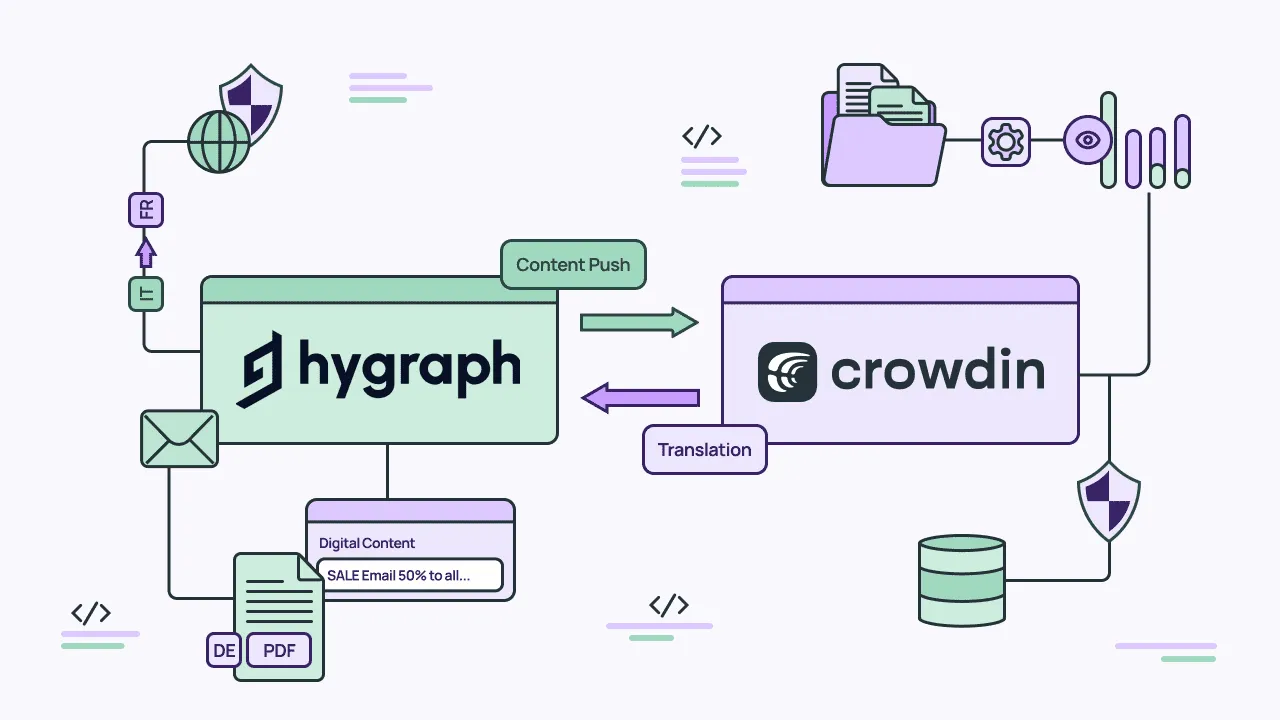
Through integration, content can be pushed directly from Hygraph to Crowdin. Translators always work with the latest version, eliminating the need for manual exports and imports.
This keeps the entire process aligned and up to date.
Translation management and collaboration in Crowdin
Crowdin provides a dedicated environment for localization teams to build a localized website. Translators can work collaboratively, maintain consistent terminology, and manage translations across multiple languages.
Advanced Crowdin features for Hygraph users
- Context: Since Hygraph is a headless CMS, translators often lack visual cues. Crowdin allows you to upload screenshots or use a WYSIWYG file preview, so linguists see exactly where the content sits in the UI, reducing layout breaks and errors.
- Translation Memory (TM) and glossaries: Avoid translating the same UI element or product description twice. Crowdin’s TM stores every approved translation, saving costs, and its glossary feature ensures brand consistency across all global markets.
- AI-powered workflows: Leverage Crowdin AI to pre-translate content while adhering to your specific style guides. This allows regional teams to shift from “translating from scratch” to “reviewing and refining”, increasing speed-to-market.
- Automatic Quality Assurance (QA): Crowdin automatically flags issues like mismatched placeholders, broken HTML tags, or inconsistent terminology before the content is synced back to Hygraph, preventing bugs in production.
This centralization improves quality and reduces inconsistencies.
Automated delivery back to Hygraph
Once translations are complete, localized content is automatically synced back into Hygraph. There is no need for manual copy-pasting or version tracking.
The system remains connected, reducing operational overhead.
Locale-based publishing control
With translations in place, teams can publish content per locale directly from Hygraph. This enables faster releases in priority markets while maintaining a consistent global structure.
The workflow supports both speed and control.
Building multilingual websites with governance in mind
Content governance should not be treated as an afterthought. It needs to be embedded in the content architecture and workflows from the beginning.
Organizations that invest in structured content models and efficient localization workflows gain clear advantages. They launch faster across markets, maintain consistent messaging, and reduce the operational burden on their teams.
Managing multilingual content is not just about translation. It is about building a system that can scale without losing control.
Stop manual content transfers.

Jing Li
Jing is the Organic Growth Lead at Hygraph. For the past four years, she has written about headless CMS, structured content, and API-first architecture for product and digital teams. At Hygraph, she focuses on making complex infrastructure concepts accessible to the teams who need them most.