

The web was built page by page. A homepage, a product page, a blog post — each designed, written, and published individually to one primary channel: the website. And for a long time, that worked. But the digital world has changed: it’s faster, it’s multi-channel, and now it’s AI-search driven.
Content doesn’t live in one place anymore. It’s distributed across websites, apps, social media, AI search engines, and more. The brands showing up well across those channels aren’t just publishing more — they’re publishing smarter with content structured so any system, human, or AI agent can understand exactly what it is and what it’s for.
What is content modeling?
A content model is the blueprint behind your content. It defines the types of content you create — a product, a blog post, an FAQ, a testimonial — and breaks each into constituent fields: a title, a summary, a category tag, a CTA, an author. Rather than one undifferentiated block of text, each piece of information becomes a specific, purposeful field with a clear role.
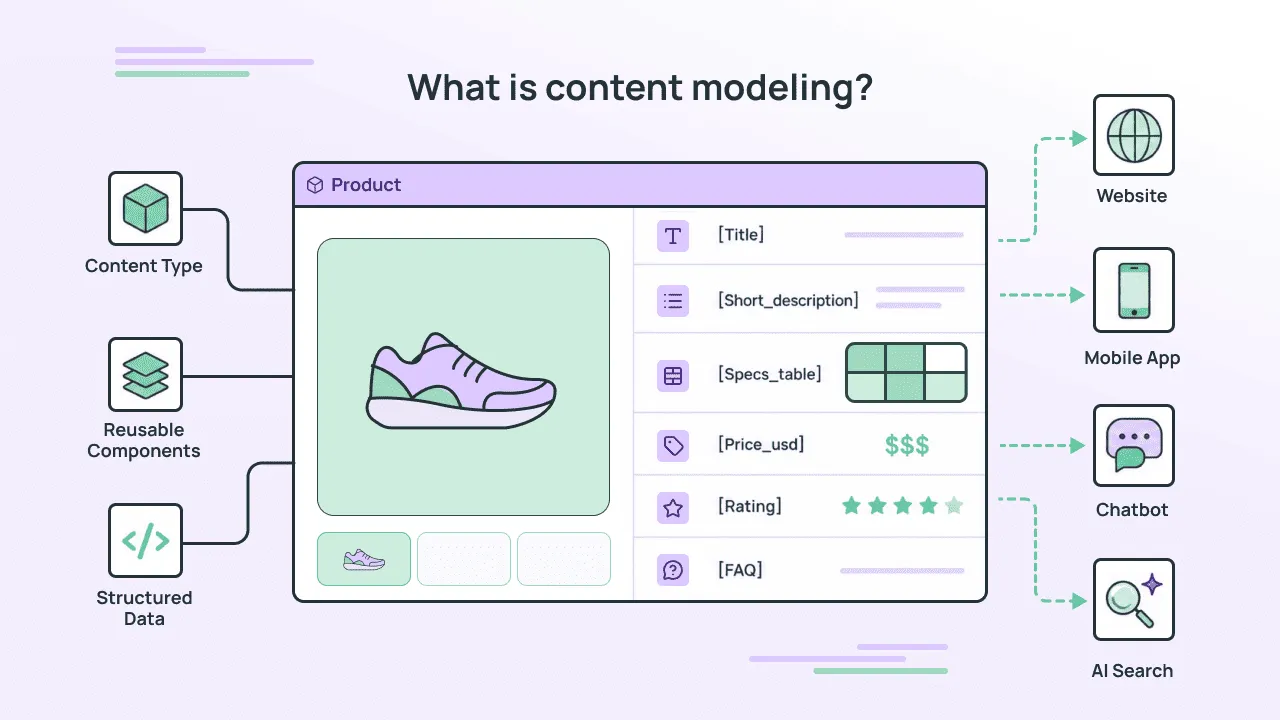
Take a product page. Instead of a single block of copy, a content model breaks it into discrete fields: product name, short description, key specifications, pricing context, customer FAQs. Each field has a defined purpose, so the same information can populate a website, a mobile app, a chatbot response, or an AI search result — without rewriting or reformatting anything. The result is content that isn’t tied to a single page or layout. It can be assembled, reused, and delivered anywhere — because its meaning is built into its structure, not its design.
How does AI impact content modeling?
As we now know, AI search engines don’t just crawl pages. They parse structured data, prioritize semantic clarity, and favor content that directly answers specific questions. Unstructured content is difficult for AI systems to interpret with confidence. Well-modeled content — with distinct fields for product specifications, FAQs, pricing context, or brand messaging — gives AI the signal it needs to surface your content accurately and authoritatively.
When a customer asks an AI assistant what your product does or whether it’s right for them, you want the answer to come from your content. Structured content modeling is what makes that possible by giving AI systems the clarity and consistency they need to find, interpret, and trust what you publish.
The modularity advantage
Structured content is also easier for teams to work with. When content is broken into reusable components rather than locked inside page layouts, you build once and publish everywhere — from one source of truth. When a product name changes, you update it in one place, and every channel reflects it automatically. No missed instances, no version drift.
This is where a headless content management system (CMS) becomes essential. Unlike traditional CMS platforms, where content and presentation are tightly coupled, a headless CMS stores content as pure, structured data and delivers it via API to any front end or channel that needs it. Platforms like Storyblok are built around this model — giving teams a visual editing experience while keeping the underlying content fully structured, portable, and optimized for human and AI consumption.
The result is a content operation that scales through smarter work, not more of it. And that scalability becomes even more powerful when content needs to reach audiences in multiple languages — because when every field has a clear purpose and defined scope, translation and regional adaptation can happen at the component level, with precision and consistency across every market you serve.
The localization advantage
Content modeling doesn’t just make your content AI-ready – it makes it translation-ready. In a traditional setup, translators often have to deal with one giant, undifferentiated block of text. They simply can’t figure out which part is a headline and which is a technical product specification.
When your content is structured into specific fields (such as a title, a summary, or a CTA), localization occurs at the component level. This gives you a few major wins:
- Maintain precision: translate a feature name consistently across all languages.
- Adapt strategically: If a specific market needs a different CTA or a unique regional disclaimer, you can swap out that specific component without rebuilding the entire page.
- Eliminate version drift: Since content is stored as pure data, an update to a source product name can automatically trigger updates across all localized versions, ensuring your brand stays consistent from Tokyo to Berlin.
Better together: Crowdin x Storyblok integration
While Storyblok provides the structured foundation, Crowdin provides the localization ecosystem to connect and automate your multilingual content delivery. With Crowdin x Storyblok integration, you can easily connect your content creators and your localization team, turning manual processes into an automated, continuous workflow.
How the Crowdin x Storyblok integration works
The integration connects your Storyblok spaces directly to your Crowdin projects.
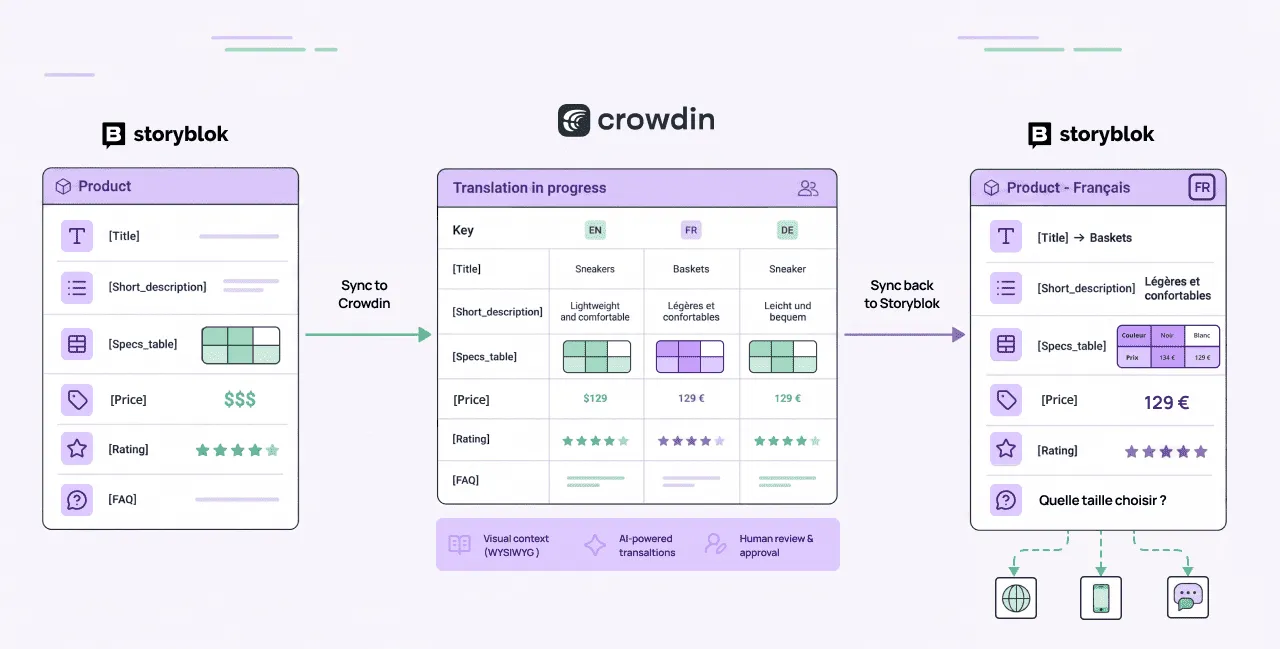
- Sync with a click: You can manually or automatically sync your Storyblok stories and components to Crowdin for translation.
- Context-rich translation: Crowdin provides translators with a WYSIWYG preview. They don’t just see a list of strings. Instead, they see exactly where that text lives on your Storyblok site, leading to higher accuracy and fewer layout breaks.
- Automated sync back: Once translations are approved in Crowdin, they are synced back to Storyblok. Your localized pages are ready to be published without any manual copy-pasting.
Why do you need a TMS for advanced CMS localization
Storyblok offers excellent native localization for managing content within its Visual Editor, but as your project scales, you may need a dedicated Translation Management System (TMS) like Crowdin to handle complex operations. Crowdin acts as a specialized layer for multilingual operations, offering several advantages over a ready-made CMS solution:
- You can design multi-step workflows that involve automatic pre-translation, human review, and legal proofreading before content ever returns to Storyblok.
- Maintain a single translation memory and glossary across all your digital assets (including your website, mobile app, and CRM templates), ensuring your brand voice is identical across every touchpoint.
- Crowdin allows you to manage vendors, track translator productivity, and estimate localization costs with detailed reporting.
Flexibility for every workflow
The power of Crowdin lies in its ability to mix and match technology and human expertise to fit your specific needs:
- Leverage AI and MT: Use Machine Translation engines (like DeepL or Google Translate) or AI-powered providers (like OpenAI and Anthropic) to generate translations.
- Context-aware AI: Crowdin’s AI doesn’t just translate; it uses your Glossaries and Storyblok context to ensure technical terms and brand-specific terms are handled correctly.
- Human-in-the-Loop: Easily assign tasks to professional agencies, in-house teams, or freelancers.
- Hybrid efficiency: Many teams use AI for pre-translation, then have linguists polish the final output – leading to time savings of up to 90%.
Conclusion
In a world where content must serve humans, AI agents, and different markets simultaneously, the “one block of text” approach is no longer sustainable.
Treat content as a modular asset, so whether an AI is parsing your data or a customer is reading your website, the message remains clear, accurate, and relevant.
The question is no longer how much content you can produce, but how well that content can be distributed, adapted, and performed across the internet. Storyblok and Crowdin provide the actual infrastructure needed to scale to new markets.
In short: model your content once, use it everywhere, and let your tools handle the distribution and translation. It’s the only way to stay consistent and time-to-market.
Make your CMS content multilingual and AI-ready

Keren Burns
Keren Burns a Senior Content Marketing Specialist at Storyblok. She loves reading, music, traveling, and writing up content in the tech space.